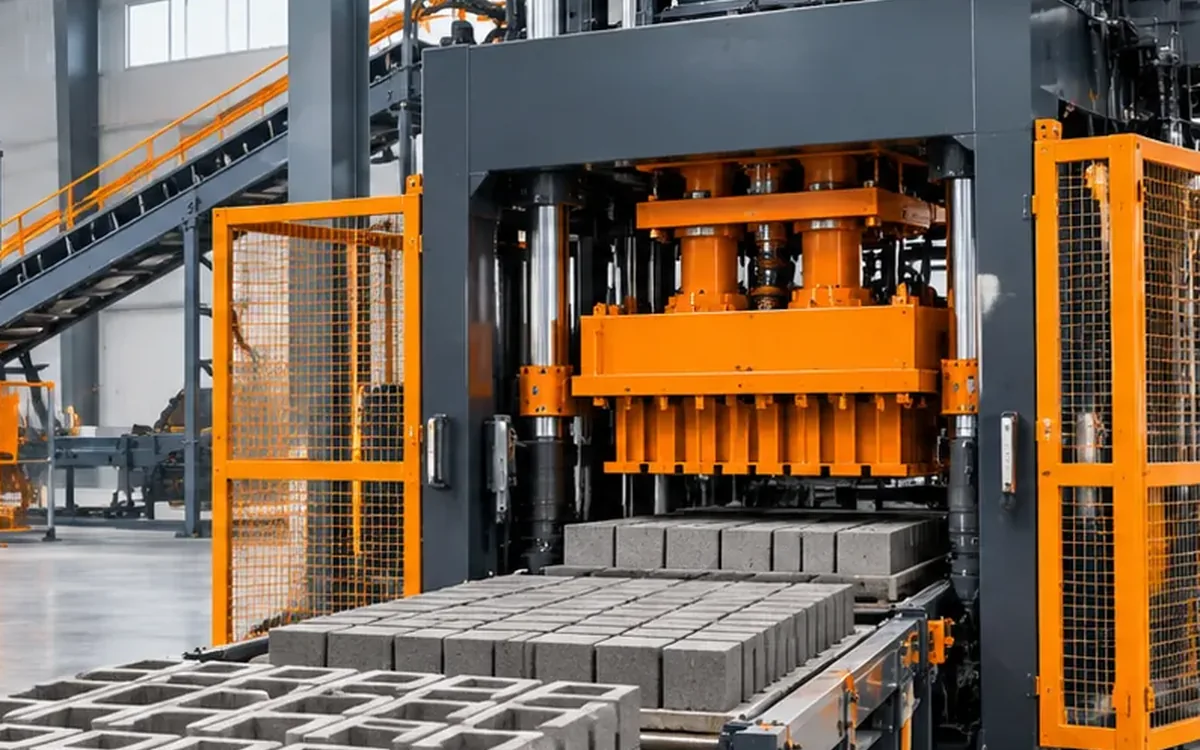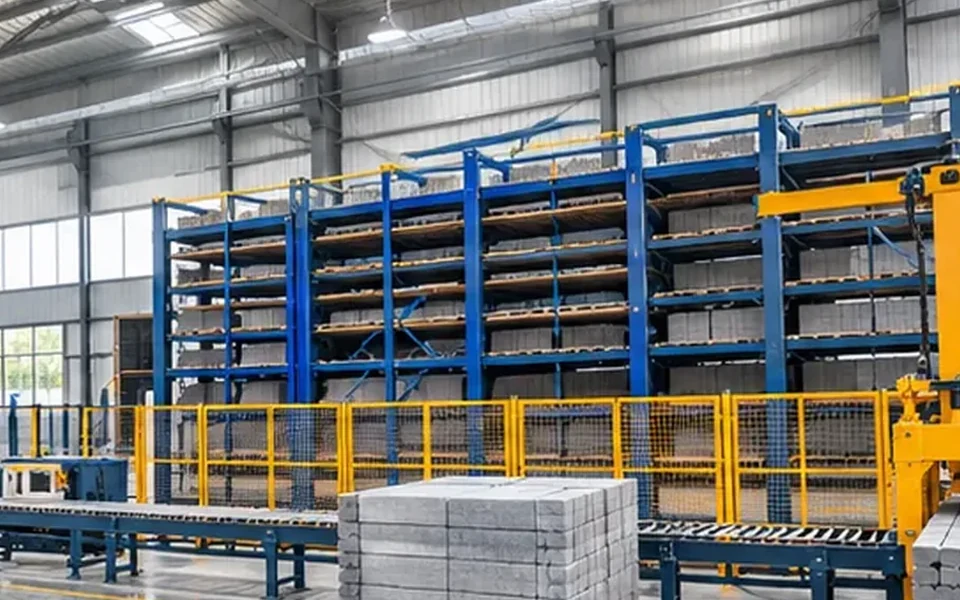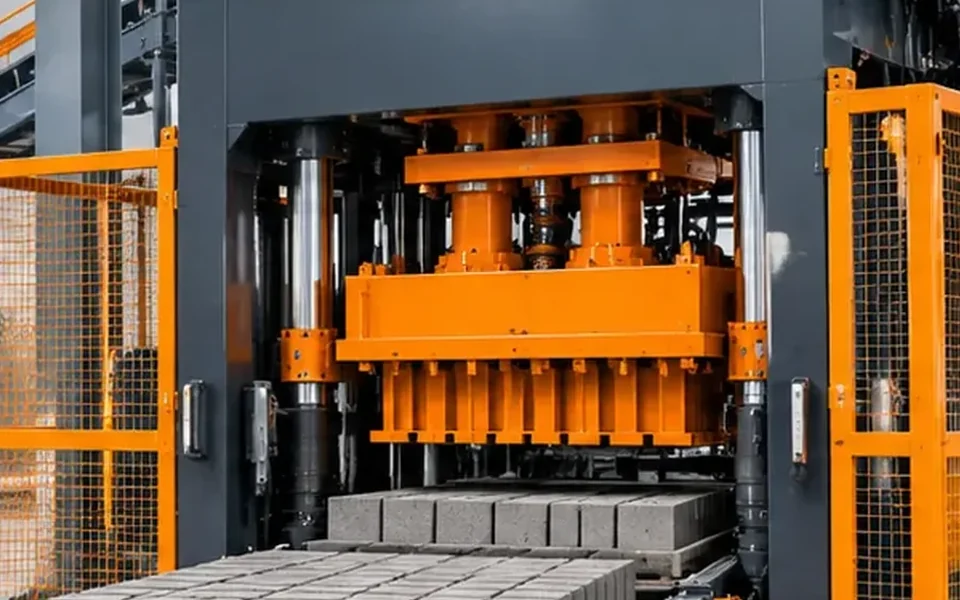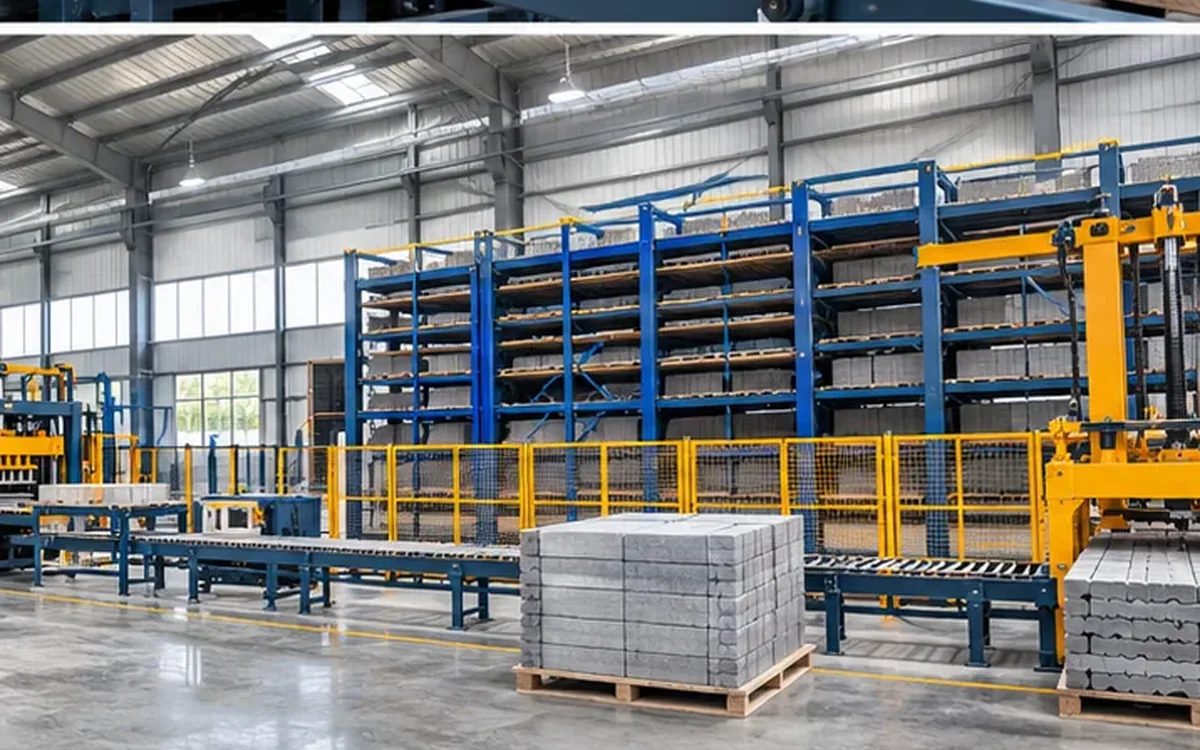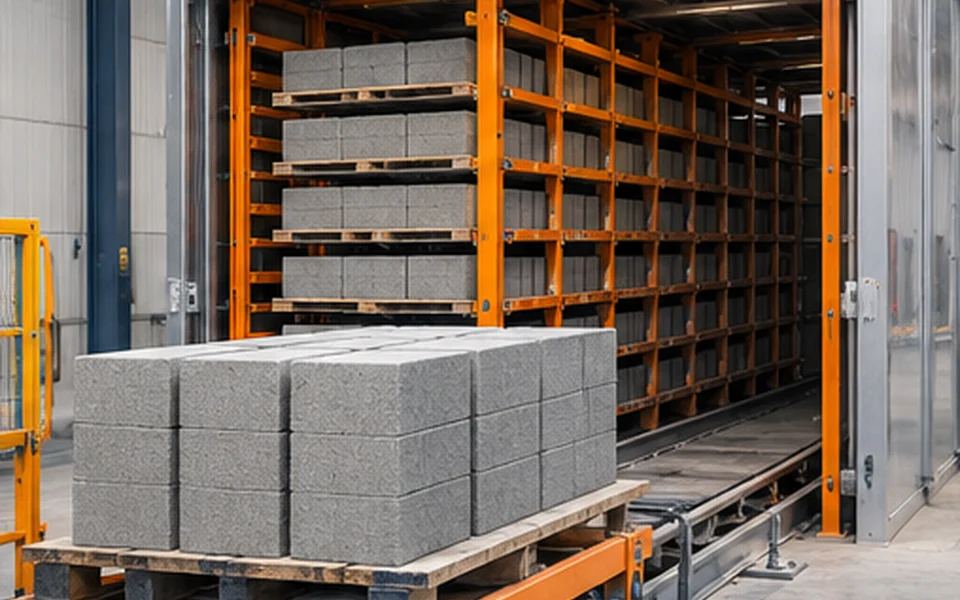
Wet-product transfer, curing storage, pallet return, cubing and finished-product logistics.
Output is constrained downstream
A block press only forms the product. The facility must then transport green blocks or pavers without damaging their edges, provide sufficient curing capacity, and transfer cured products into manageable stacks or bundles.
When planners focus only on the pressing cycle, they often underestimate pallet stock, rack space, handling bottlenecks and the forklift routes required for a continuous operation.
Planning the production loop
Match elevators, lowerators, rack spacing, transfer cars and cubing systems to the product family and intended batch flow. Curing time is not interchangeable with machine speed; temperature, moisture and mix design must be assessed for each project.
- Fresh-product stability and transport speed
- Curing method and storage layout
- Pallet circulation and washing
- Cubing pattern and packaging
- Warehouse and dispatch routes
Safe, repeatable handling
Equipment access for cleaning and maintenance should be designed into the line. A plant that handles several product formats also needs procedures for changing stacking patterns and confirming stable finished pallets.
Follow the product after the forming stroke
A block machine creates a fragile green product, not a packaged unit ready for sale. Fresh blocks and pavers need smooth transfer, adequate curing conditions and a controlled route into finished-product handling. Evaluate where a pallet travels after leaving the press, how it is supported and when it can be safely lifted. Roller alignment, acceleration and conveyor transitions can cause chipped edges even if the forming process was stable. Confirm the full pallet and product mass for the heaviest mould, not only the normal hollow block. The timing of the next transfer also depends on whether the elevator, rack and curing storage have open positions. A strong handling design prevents downstream stations from repeatedly stopping the press.
Curing capacity should be based on the number of pallets produced per hour and the time they must remain in controlled conditions. The appropriate period depends on the concrete mix, local climate, product requirements and curing method; it should not be inferred from one generic number. Estimate simultaneous inventory at ordinary and peak shift rates, allowing for rack loading, retrieval and maintenance. Keep separate counts for full pallets, empty pallets, positions in transfer systems and any staging queue. A nominal rack count is not sufficient if some shelves cannot accommodate tall kerbstone products or particular pallet footprints. Capacity planning must also consider what happens when a curing cycle is extended or dispatch of finished stock slows unexpectedly.
Avoid damage in wet-side transport
Freshly formed units can deform if a pallet is tilted, vibrated or stopped abruptly. Elevator movements, transfer forks and rack loading should remain within the supported product and pallet conditions. Request a demonstration with both a standard block and the most demanding proposed unit. Look for edge abrasion, shifting at pallet corners and unstable tall sections. A smooth path through the wet side is more valuable than a fast conveyor that frequently produces rejected material. Operators need safe procedures for a misaligned pallet or a partial stack. The design should also make it possible to reach inspection areas without entering hazardous motion zones. Damage reduction is a function of coordinated mechanical handling and process timing, not simply a stronger press.
The dry side should handle product only when curing and the agreed product quality conditions allow it. A rack retrieval schedule needs to identify which pallet or batch has completed the required period. If products have different thicknesses or mix recipes, they may not all be ready at the same time. Ask how the plant records batch identity and prevents an operator from removing the wrong rack under time pressure. Dry-side lowerators, conveyors and inspection points should provide a steady flow without overloading the cubing station. The handling cycle must be balanced against both curing turnover and press output, because either end can restrict the whole factory. Establish a practical exception procedure for batches needing additional cure time or quality checks.
Build packs around the dispatch requirement
A cubing or packing system must form stable loads that suit the products and the vehicles used for delivery. Hollow blocks may be arranged differently from pavers or heavy kerbstones, and visible surfaces may require protection. Define the package dimensions, layer pattern, pallet use and expected wrapping or strapping method before choosing a gripper. Clamping pressure should secure finished units without damaging edges; gripping performance needs to be tested with representative product conditions. The orientation required by the customer should also be considered because inconvenient packs may add handling work at the destination. A good layout provides space for forklift collection, damaged-unit segregation and safe maintenance without interfering with the empty pallet return path.
Production pallets represent working capital and a recurring maintenance responsibility. Map the return route from the dry side to the press, including cleaning, rotation and stacking or inspection where necessary. The total number required depends on the curing time, shift pattern, line speed and the number held in intermediate stations. A damaged pallet can affect both product dimensions and machine reliability, so an inspection method should be documented. Include space for reserve pallets and a controlled way to remove unsuitable ones from service. If an existing pallet stock will be reused, verify dimensions, flatness, permissible loading and contact surfaces with the new equipment. Optimizing the return loop can prevent expensive stops without increasing the forming machine's theoretical capacity.
Fault recovery and handling safety
Transfer equipment, elevators and cubing grippers create moving and suspended loads that need clearly defined safeguards. Specify how the system detects an occupied position, a missing pallet or an incomplete grip. An alarm should identify the affected station and guide staff toward a safe recovery method. Test restart after a downstream blockage, a missed sensor and a controlled power interruption, respecting the machinery's safety design. Maintenance staff require practical access to bearings, guides, chains, gripper elements and sensors without entering an unsupported or hazardous area. The controls must distinguish routine production commands from maintenance isolation. A system that can recover predictably after ordinary disruptions can be more productive than a faster system that regularly requires lengthy manual intervention.
For a useful proposal, supply the pallet footprint and load, product drawings, target shift output, curing approach and the finished stack formats preferred by customers. Identify the site space for racks, forklift routes and dispatch staging. Clarify whether the scope starts immediately after the press or includes curing infrastructure, dry-side separation, cubing and pallet return. Ask for acceptance tests involving both the lightest and heaviest product. Review the fresh-block elevator, curing rack circulation and cubing station as connected equipment. The curing and cubing line page describes the whole downstream route.