
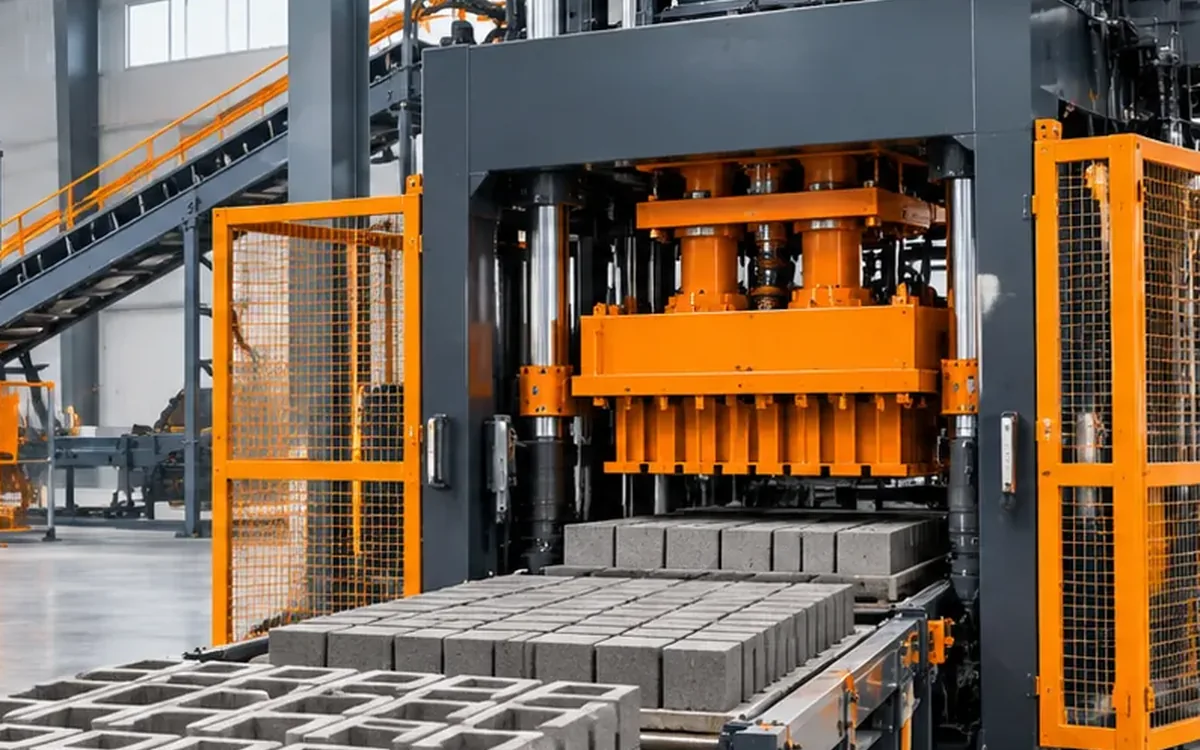
Production pallets are temporary carriers for fresh concrete units, but their availability and condition determine whether a block press can keep working. A pallet magazine and cleaning conveyor should be planned as part of the complete pallet circulation system. The important questions are how pallets are accumulated, checked, presented to the machine and returned after dry-side handling, not merely how fast a magazine can release an empty pallet.
Define the pallet format and circulation requirement
Start with a drawing of the actual production pallet: overall dimensions, thickness, material, permissible deflection and relevant surface characteristics. A conveyor that handles one pallet format may not handle another simply because the outside width is similar. Support points, roller pitch, lifting contact and accumulated pallet weight affect how the system behaves. The planned number of circulating pallets depends on the press duty, curing residence time, transfer delays and the storage arrangement. If the stock is too small, the press can wait for returning pallets; if it is excessive, the factory may occupy unnecessary space and tie up capital. A working circulation model should represent actual production shifts and not assume that every pallet returns immediately after forming.
The magazine must supply a consistent, correctly positioned pallet to the machine entrance. Ask how the equipment distinguishes a single pallet from two stuck together, how warped or damaged pallets are detected and how the system responds when the receiving conveyor is full. In a compact plant, the magazine can become an unexpected constraint if loading requires frequent forklift movement across the operator route. Larger plants may need more accumulation and controlled handover points. The curing and pallet circulation equipment page provides context for the wider loop in which the magazine participates. Reliable forming depends on both the quality and the timing of every pallet entering the press.
Cleaning method, surface condition and quality
Residue on a returned pallet can influence the surface of newly formed blocks, interfere with mould seating or create a mechanical jam. The cleaning method should be selected for the pallet material, the type of residue and the plant’s housekeeping needs. A scraper, brush or other contact system must remove problematic material without damaging the pallet surface or shortening its service life unnecessarily. Ask how worn cleaning elements are adjusted and replaced and whether different pallet types need different settings. A visually clean pallet can still be distorted or have damaged edges, so cleaning should be paired with appropriate inspection rather than treated as a complete quality check.
Consider the collection of removed residue. Hardened concrete fragments and fines need a controlled path into bins or other containment so they do not accumulate beneath conveyors and return to the machine. Depending on the process, dust or wash water may require additional environmental controls. The equipment should allow housekeeping access without people reaching beneath moving belts or rollers. Agree on a routine for checking the cleaning effectiveness at the start of a shift and after changing pallet material. A reliable system prevents contaminated pallets from re-entering production, but only if operators are able to identify when the cleaning station itself needs service.
Magazine mechanics and safe feeding logic
The magazine should support stored pallets without damaging lower units or allowing uncontrolled release. Check how the stack is located, which devices separate individual pallets and how the mechanism recovers if a warped pallet obstructs the path. A sensor that merely counts a movement cannot prove a pallet reached the required position; the control logic may need confirmation from downstream detectors. Request a description of normal start-up, planned stops and restart after power loss. If staff load the magazine manually or by forklift, the procedure must prevent a loading vehicle from entering the active release area. Mechanical guards and access interlocks should be integrated with the actual operation rather than added as decorative elements.
The system should also deal with variation in pallet stack height and changes in return rate. It is important to know when an empty magazine causes the press to stop and how early operators receive a useful warning. A poor design may allow a machine to begin a forming cycle without a properly seated pallet, creating both quality and safety risks. Conversely, unnecessary stops can accumulate when detectors are placed where dust and concrete fragments obscure them. Discuss sensor location, cleaning access and fault messages. The correct release frequency follows the downstream machine’s readiness and the buffer conditions, not a standalone cycle-time target used without regard to the rest of the line.
Return conveyor layout and transfer accuracy
Empty pallets often travel from the dry side through several transfers before returning to the forming machine. Every corner, lift and handover can become a source of delay or misalignment, particularly when pallets are worn. Review the physical route including crossing points, service clearance and the way full or empty accumulation zones are managed. A conveyor that appears efficient in a line drawing may obstruct access to curing racks or maintenance equipment once installed. The plant designer should make both the flow and the working areas visible in the layout. A guided transfer should hold pallets securely without excessive contact forces that damage their edges or create jams.
For a plant that has several forming or cubing modes, the return system may need controlled routing. Ask how the controller tracks the destination and availability of empty pallets and what happens if a downstream device is isolated for service. The transfer path should allow a safe way to remove a broken pallet without dismantling guards or dragging material beneath moving conveyors. The automatic curing and cubing line is useful when considering how a missed empty-pallet return eventually affects the press. The objective is stable circulation, not simply a high conveyor speed. Buffer placement and maintainable transfer points are more important than nominal transport capacity alone.
Inspection, wear management and operational records
Production pallets have finite service lives and should be inspected against the requirements of the press and handling devices. The factory can define rejection criteria for excessive warping, damaged edges, cracked surfaces or other defects that affect equipment interfaces. The magazine or return conveyor may include simple segregation points, but staff must still understand why a pallet is removed from circulation. Recording recurring damage can identify a poorly adjusted transfer or an unsuitable cleaning tool. Without such records, the plant may keep purchasing pallets while the actual problem remains in the handling equipment. Service documentation should identify guide elements, drive components, wear strips and detectors that need planned inspection.
Operators should receive a concise response procedure for double feeds, missing pallets, jammed rollers and cleaning-station faults. Test whether the system stops safely and communicates the reason clearly to the relevant workstation. Maintenance personnel need safe isolation and access to the devices most likely to collect debris. Regular checks should be integrated with production planning so the pallet return system is not treated as a low-priority auxiliary until it causes a press shutdown. If multiple pallet formats are in use, keep adjustment settings and compatibility records visible. A well-managed pallet loop allows the forming machine to operate more consistently and helps protect mould alignment and product surfaces.
Scope and acceptance of a pallet management system
A detailed enquiry should include pallet drawings, material types, expected circulation quantity, current or planned press, curing arrangement and dry-side layout. Supply information about available space, floor levels, crossings and how forklifts or operators access the magazine. The quotation should identify the magazine, conveyors, transfers, cleaning elements, sensors, PLC interfaces, guards and necessary installation work. Distinguish whether the supplier is responsible for integrating the existing pallet return or whether that interface belongs to another contractor. Specify the access points required to remove damaged units and maintain the cleaning equipment. These details often determine whether a practical installation is possible.
The acceptance test should run a representative flow of clean, used and intentionally isolated defective pallets, subject to safe trial procedures. Verify single-pallet release, correct detection, clear fault messages and safe recovery from an interrupted cycle. Include cleaning inspection and observation of residue collection, not merely the number of pallets moved per hour. Ask for spare parts, maintenance schedules, control backups and operator training. A complete system is judged by its effect on the continuity of the forming and dry-side processes. The procurement decision should favour a transparent, serviceable arrangement that matches actual pallet conditions over a catalogue description promising effortless circulation.