
Concrete masonry units for building projects
Hollow and solid concrete masonry units support many structural, partition and infill applications, but the correct production method depends on the finished geometry and local performance requirements. A hollow block with thin webs and several cores demands different feed and compaction behaviour from a dense solid unit. The selection process should begin with approved product drawings, intended dimensions and the concrete mix components available near the factory. The manufacturer must consider how each core is supported in the mould, whether aggregate can flow into narrow sections and how the product will release without damage. Pallet flatness and mould alignment can become decisive even when a press appears to have sufficient nominal capacity. Product samples and agreed dimensional checks should therefore be part of the evaluation process.
Market demand affects equipment requirements as much as geometry. A manufacturer supplying a narrow range of wall blocks in long runs may prioritise stable cycle-to-cycle repeatability and predictable pallet circulation. A business serving custom building projects might value fast mould changes and clear tooling storage procedures. Factories should also consider whether finished units are strapped, wrapped or loaded in another manner, since package stability affects downstream equipment. See the concrete block machine range for equipment classes and the complete production-line overview for the surrounding process. These resources connect end-product quality to forming, curing and dispatch rather than treating the press as the sole production decision.
Interlocking pavers and hard-landscaping products
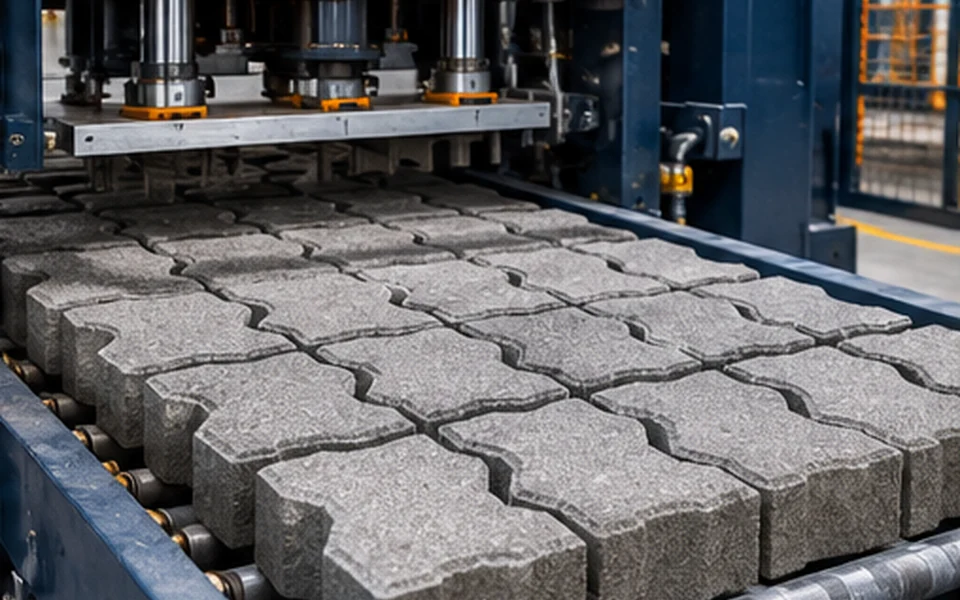
Interlocking pavers and decorative paving units are purchased for surface appearance, geometry, edge quality and performance under the specified use conditions. Their production may involve special mould cavities, a face-mix layer, controlled colouring and stricter handling of visible edges. A facility planning multiple colours should think carefully about pigment storage, batch separation and cleaning access to avoid unwanted colour carryover. The paver mix may need a different moisture or aggregate distribution from ordinary masonry blocks, and the forming process has to deliver consistent compaction across the pallet. Sales volumes are often expressed in finished square metres while machine output is described in pallets or pieces, so the conversion basis must be explicit when comparing line proposals.
Downstream movement matters because fresh pavers can suffer marking, chipping or uneven surfaces before sufficient strength develops. Curing racks, pallet handling and dry-side cubing should be sized for the intended mix of sizes and shift output. A higher piece count on one mould does not automatically mean greater saleable output if defective products increase or packaging takes longer. Manufacturers planning landscape collections may need more mould families and deliberate product-change schedules, rather than maximising a single line's theoretical cycle speed. The paver machine category and automatic paver production-line page explain these relationships and provide questions to discuss during equipment selection.
Kerbstones, edging and civil infrastructure
Kerbstones, road edging, drainage-related units and heavy concrete profiles can impose demanding conditions on the forming and handling process. Their dimensions and mass influence mould count per pallet, loading forces, equipment clearances and the type of lifting equipment used after curing. A product may fit a press in plan view yet still be unsuitable because the forming stroke, stripping height or downstream handling system does not accommodate its geometry. Infrastructure purchasers may also specify particular shapes, tolerances or material performance requirements that change the tooling concept. It is important to know whether production will focus on a single kerb profile or alternate between large profiles and conventional pavers.
A kerbstone plant should allow safe inspection and movement of heavy tooling. Changeover devices, lifting plans and the storage position for mould assemblies are important parts of reliability. Fresh product transfer must prevent instability while cured product stacking needs appropriate protection for exposed corners. The relationship between the press and forklift operations deserves attention in the layout phase, especially when large finished units are dispatched in mixed shipments. The kerbstone machinery category addresses forming needs, while the heavy-duty mould overview discusses the tooling details that influence output consistency.
Multi-product factories serving varied markets
A facility serving building contractors, municipal works and landscape distributors may wish to produce blocks, pavers and kerbstones on one equipment platform. Such flexibility can be valuable, but it must be measured against actual changeover labour and the time needed to prepare each product family. Different products may call for alternative moulds, tamper sets, surface-feed equipment, concrete recipes or packaging arrangements. Production planning should consider order sizes and the effect of interrupting one product campaign to run a smaller order. A press designed for multiple formats is useful only when the surrounding factory can accommodate the different pallet loads, curing demands and packing specifications. Otherwise flexibility becomes an expensive series of delays.
A credible multi-product plan lists the proposed products separately and tests representative examples from the most difficult families. It also clarifies which tooling is included initially and which would be purchased later. Material supply needs to handle variation without forcing unplanned contamination between mixes, while the control system should make product recipes and operator responsibilities understandable. A review of the integrated block, paver and kerbstone plant provides a framework for assessing the full flow. The machine and mould selection guide helps buyers distinguish theoretical format flexibility from a workable production programme.
Concrete product manufacturers building a first plant
New producers often begin with a target product and a planned market price, then discover that the forming machine is only part of the required investment. A site also needs aggregate storage, mixing, utilities, controlled product handling, curing space, maintenance access and dispatch routes. Early decisions should identify the realistic daily sales volume and the product characteristics customers expect. A compact installation may be sensible for an initial range, provided that labour, raw-material delivery and handling costs are evaluated honestly. The project budget should include moulds, pallets, spare components, installation work, testing and the required operating space rather than allocating the majority to the press itself. The cheapest machine is not necessarily the lowest-risk production system.
The first plant layout should also plan for imperfect operating conditions. Staff need room to clear a blocked pallet, clean a feed drawer, replace a wear item and inspect a conveyor safely. Buyers should ask what a normal start-up, shift change and shut-down sequence looks like, and what happens when a critical component fails. Training requirements may determine whether manual handling is realistic at a proposed output. A layout that can be maintained and cleaned efficiently tends to be more valuable than a compact drawing that cannot accommodate normal service activity. The compact block factory concept and pre-purchase questions are helpful starting points for this type of investment.
Established factories upgrading equipment
An existing block or paver operation may seek better forming consistency, reduced labour dependence, lower maintenance exposure or a wider product portfolio. Before proposing new equipment, the current plant should be assessed for bottlenecks across mixing, pressing, curing and packing. A faster press may simply push delays downstream if pallet inventory and rack capacity remain unchanged. Upgrading automation also requires checking sensor positions, guarding, existing electrical systems and the way staff recover from faults. Retrofit choices should be based on measured operating conditions, including production availability and recurring quality issues, not merely on a catalogue comparison with newer equipment.
Where existing moulds, pallets or conveyors are retained, their dimensions and physical condition must be verified before interface promises are made. A plant may need supporting changes to foundations, utilities, machine guarding or product flow that are not visible in an equipment-only quotation. Gradual upgrades can sometimes reduce disruption, but they also create compatibility challenges when equipment from different periods is connected. Document responsibility for integration and testing, including the expected downtime during installation. The automation and line integration section explores these choices, and the maintenance planning page helps frame the operating-life implications of the upgrade.
Production planning for varied climates and raw materials
Concrete product manufacturing relies on locally available aggregates, cement and water, and those materials are not interchangeable merely because they share a familiar label. Aggregate grading, shape, absorption and moisture influence compaction and finished-product appearance. A mix proven at one facility may require testing before use with a different source or under different ambient conditions. Plants in humid, dry, cold or high-temperature environments also face different curing and storage concerns. The selected equipment should allow operators to observe and adjust the process based on agreed testing procedures. A useful technical brief therefore records material sources and environmental conditions instead of assuming a generic recipe will behave identically everywhere.
Logistics and infrastructure can also shape the plant concept. Site access for trucks, electrical supply reliability, water availability, dust handling and the movement of finished goods may be as important as the preferred press size. Projects should identify applicable local rules for structures, machinery safety, concrete product testing and environmental operations. None of these obligations can be verified from a broad machinery description alone; they need project-specific engineering and local review. The moisture and water dosing module and twin-shaft mixing overview show why material consistency remains central when production moves into a new environment.
From application to a measurable equipment brief
Across all these industries, the most productive first question is what finished product will be sold and how acceptance will be determined. Start with a product drawing, its intended use, the expected quality requirements and the mix design assumptions. Add the likely shift pattern, number of products in the programme, packaging format and any relevant site limitations. This information lets suppliers discuss machine suitability, mould interfaces, curing inventory and handling equipment in practical terms. Where drawings or material tests are not yet available, identify them as open project tasks rather than allowing a proposal to conceal the uncertainty. A buyer benefits when each item in the proposed scope can be traced to an actual manufacturing need.
The next stage is to compare proposals on a common basis. Ask for a clear equipment list, an explanation of line output assumptions, interface drawings, utility information, safety and service requirements, and an agreed approach to commissioning. A realistic acceptance plan should use representative finished products and include both normal production and recovery from selected faults. Keep optional automation and future expansion separate from the initial essential equipment so commercial comparisons remain clear. To continue, review the applicable machine category, explore the production-line concepts, or describe your manufacturing project. The goal is a technical discussion based on the products and site conditions that actually matter.