
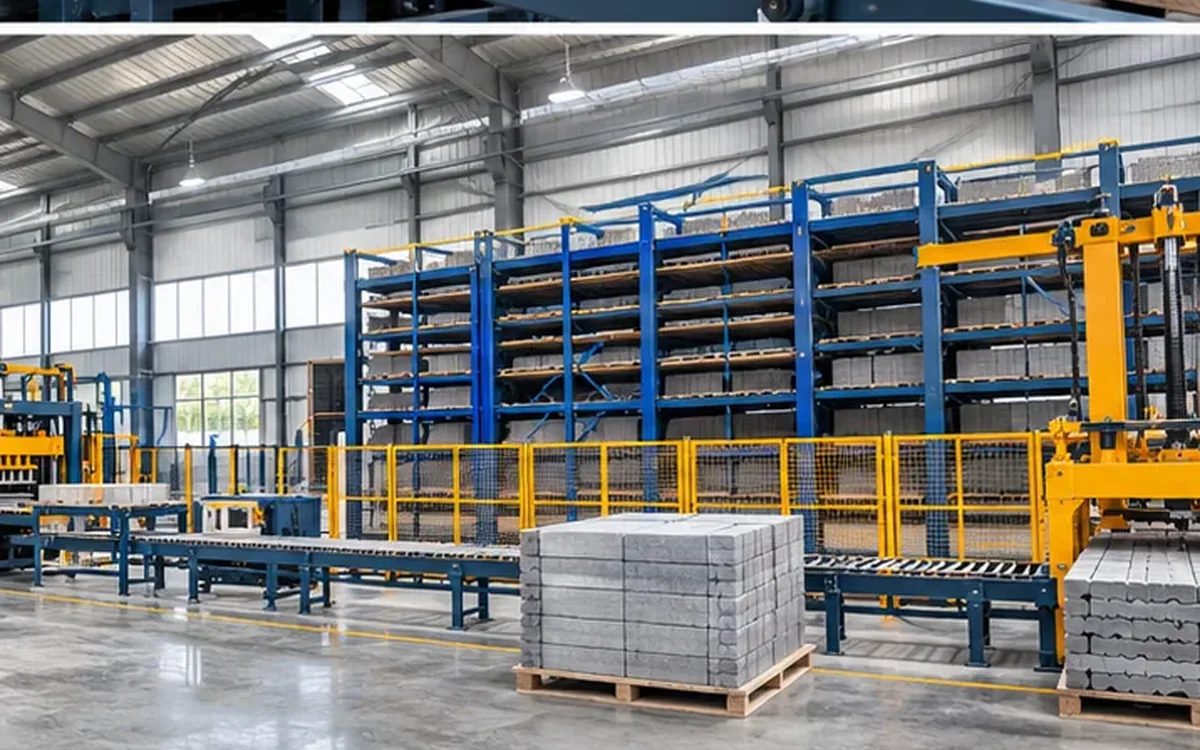
Control scope and transfer coordination for a plant that operates as one production process.
Automation can coordinate material dosing, mixing, moulding, pallet transport and finished-goods handling, but it should be designed around a stable process flow.
We help frame the questions that should be resolved before integration: interfaces, recipes, safety states, operator access, alarms and service procedures.
The preferred level of automation should reflect production schedule, available labour, maintenance resources and any later expansion.
For automation & line integration, prepare the operating brief with relevant product types, production hours, available space and any existing machinery that must be considered.
Review production line arrangements or individual equipment categories to prepare your brief.
Define the process sequence before selecting controllers
Automation should describe a real material and pallet journey rather than a list of PLC brands and screens. Document how batching releases material to the mixer, when the mixer can discharge, how the press confirms pallet presence and which downstream equipment signals that it can accept another fresh pallet. Include normal starting, stopping, product-change and emptying sequences. A line may have individually modern machines yet perform poorly because the interfaces disagree about who owns a particular movement. Assign a responsible device and clear signal definition to each transfer. Delayed ready signals, full racks and missing pallets should cause predictable behaviour, not improvised operator interventions. Only after the operating sequence is accepted should the controller architecture and communication method be finalised.
Build clear boundaries between independent equipment suppliers
An integration project often combines a mixer, press, conveyors, curing racks and cubing equipment that were not originally designed as one machine. Make interface control a formal deliverable. Each supplier should identify digital signals, communication data, power connections, operating modes and permitted fault resets. Agree on what happens when a conveyor trips during discharge or a rack reaches capacity while pallets remain in transit. Avoid connections that allow several controllers to command the same actuator without documented priority. Use simulation or staged commissioning tests where practical to reveal timing problems before the complete line is loaded. Record software versions, user access and backup responsibilities. An installation that depends on one visiting technician's memory is not a maintainable industrial automation solution.
Treat safety states as part of the architecture
Safety-related functions are not interchangeable with ordinary production logic. The design must consider guarding, access doors, emergency stops, safe maintenance modes, stored energy and the hazards created by transfer equipment that moves without constant operator attention. A trip in one machine does not always justify stopping every device at the same instant, but the permitted response needs a formal risk assessment. Clearing a jam may involve hydraulic pressure, gravity-loaded components and pallet loads that remain hazardous after an electrical stop. Define isolation points and verified restoration steps for technicians. Require documented testing of protective devices before the line is released to production, including after controls modifications. Automation is only successful when normal operation and recovery can both be performed safely by trained personnel.
Choose data that makes downtime understandable
A useful operator screen shows machine state, active recipe, pallet status, material readiness and the reason a cycle is waiting. Production records should distinguish a press fault from empty aggregate bins, delayed mixing or saturated curing storage. Otherwise a dashboard may report “low efficiency” without identifying which process needs attention. Decide how a stop event is recorded and whether operators can add a reason after the event. Track good pallets and rejected product separately, because a fast line that produces scrap is not performing well. For quality investigations, batch identity and recipe revision may be more valuable than a large collection of motor current graphs. Data should support concrete operating decisions rather than make the system look more sophisticated in a sales presentation.
Reserve a realistic expansion and support path
Future automation can be attractive when the first installation is built around clear interfaces. Yet expansion is constrained by electrical cabinet space, controller capacity, physical floor layout and the ability of conveyors or racks to handle added traffic. Document which expansion scenarios are actually supported: a second mixer, larger curing storage, more automatic cubing or another product family may require different modifications. Consider the expertise available locally for sensors, drives and network troubleshooting. The plant should have access to current electrical drawings, programme backups and an authorised procedure for restoring control systems. Remote support must use controlled access instead of a permanently exposed connection. Clear support ownership reduces the risk that a modest software fault becomes a prolonged production shutdown.
Commission the whole route, not just isolated machines
Test the sequence with actual pallets and representative products through planned starts, stable running, selected faults and controlled recovery. Confirm that the press does not release fresh product when the wet-side transfer cannot receive it. Check emergency-stop zoning and recovery instructions, then repeat the test after simulated supply shortages and full curing storage. Include operator training in interpreting alarms and maintenance training in identifying the correct isolation and restoration procedure. Record agreed acceptance evidence for electrical and mechanical interfaces, not merely a “line runs” observation. The PLC and HMI equipment page explains the control element, while the batching and forming line shows the process that automation must coordinate. Reliable integration means that the factory behaves predictably when conditions are imperfect.
Prepare operators for shifts in responsibility
Changing from manual interventions to coordinated line automation also changes the work performed by people. Operators may move from pushing individual pallets to monitoring material readiness, recipe selection and line alarms, while maintenance technicians need greater confidence with sensors and controller diagnostics. Define who is allowed to adjust process parameters and who authorises changes to logic or safety settings. Use a practical training plan that covers what happens during a mix shortage, a jam at the wet-side transfer and a restart after the curing store empties. Provide understandable fault messages instead of relying on unlabelled numerical codes. Train supervisors to compare useful production events with the actual product schedule so they can recognise repeated bottlenecks. A sustainable automation project leaves behind knowledge, drawings and procedures that enable the plant to recover from normal faults without needing the original commissioning engineer for every interruption.