
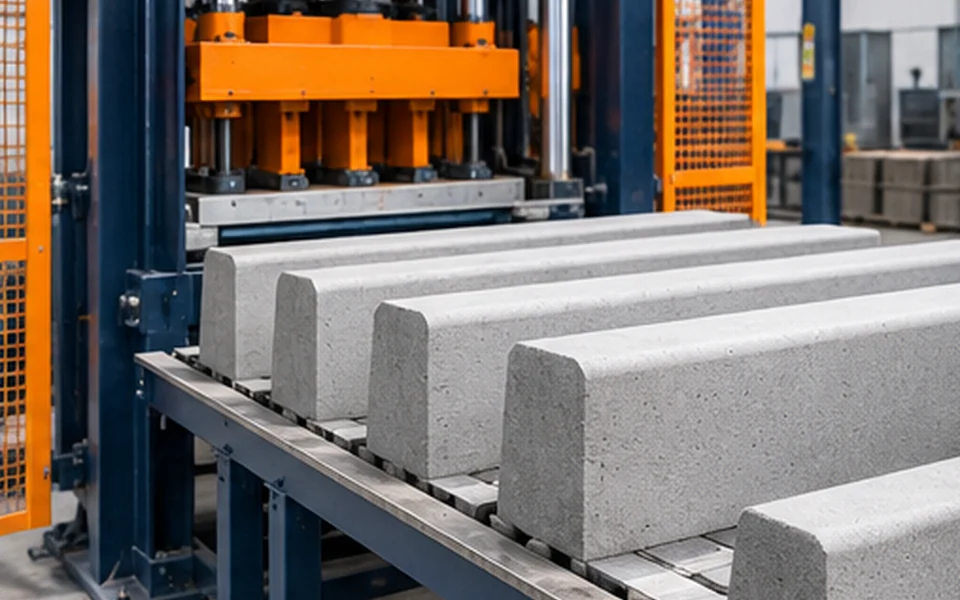
Machine and mould concepts for infrastructure kerbs, channels and heavy concrete edge units.
Planning for heavy products
Kerbstone production brings different handling demands from thin paving units. Product thickness and mass influence the mould, filling method, pallet stability, transfer system and finished-unit lifting arrangements.
The press may be able to form several kerb profiles, but changeovers should be assessed with the actual geometry, hydraulic and vibration needs, and the facility’s available lifting equipment.
Essential specification points
Document the kerbstone cross-section and tolerances before equipment selection. Confirm whether the line will manufacture straight kerbs, radius pieces, drainage channels or specialty profiles, as these introduce different tooling and stock-management requirements.
- Product drawings and dimensional tolerances
- Mould construction and wear access
- Pallet support for heavy green units
- Curing-space allocation and safe lifting
Matching the plant to the market
A successful kerbstone facility needs a practical route from raw-material storage through forming to curing, handling and dispatch. Factory layout and labour planning are as important as the machine's headline forming speed.
Treat a kerb as a handling load as well as a product
Kerbstones, drainage channels and substantial edge units usually occupy a different forming envelope from small interlocking pavers. Their length, weight and asymmetric profiles change the demands on the mould, production pallet and downstream equipment. Establish the heaviest and most awkward units before selecting a press arrangement. A machine that can compact the material may still be unsuitable if the fresh units cannot be moved reliably. Draw each product with its lifting, stacking and transport orientation. Consider whether the unit is expected to have a visible face, a drainage detail or a special corner profile. The correct starting point is a set of product drawings and factory logistics requirements, not a generic claim that the press can manufacture every concrete shape.
Long, deep or stepped kerbstone sections may be difficult to fill evenly with low-slump concrete. Check how the feeder reaches narrow shoulders and whether the distribution system causes segregation across the mould. The press and tooling must keep the finished profile stable as it is released. Trials should examine corners, drainage grooves, top arrises and any complex internal recesses. Compare products at the beginning and end of a representative run to identify changes after material feed or mould temperature shifts. Over-compaction is not automatically the answer to poor edges; the problem may lie in aggregate grading or feed distribution. Technical review should include the mixture, mould geometry and machine settings together, supported by measured samples.
Mould structure for longer concrete sections
Kerbstone tooling must resist repeated vibration and mechanical loading while keeping long edges and profile details in position. Ask for engineering drawings showing the contact and locating surfaces with the press, the tamper arrangement and the planned wear components. Stiffness and alignment are particularly important when a long narrow section is released from its cavity. Service access should allow inspection of damaged lips or worn replaceable parts without lengthy disassembly. If the product programme includes left- and right-hand sections, corner pieces or transition units, clarify which need separate tooling. A complete tooling list helps avoid underpricing the factory through an offer that assumes only the simplest kerb shape. Evaluate lifting and storage arrangements for the tooling as well as the forming machine.
A heavy product may impose a substantial load even with fewer cavities on a pallet. Check the supported pallet loading and whether flatness is maintained under the fresh weight. Transfers need to avoid sudden acceleration that shifts a long narrow unit before it gains sufficient strength. Rack shelf clearance, elevator load capacity and curing arrangement must suit the tallest profiles and the chosen pallet footprint. When several different products use the same circulation system, the limiting case can be an unusual channel unit rather than the most common kerbstone. Allocate empty rack positions according to expected curing turnover. The plant should not require operators to improvise unsupported movements when a tall or oversized mould is introduced.
Understanding mix design and visible product quality
Infrastructure units may face requirements for dimensional fit, strength, surface durability and behaviour under local exposure conditions. These need to be identified for the target market rather than assumed from a machine brochure. Aggregate selection affects both the visual finish and the ability to fill detailed sections. A consistent low-slump mix should reach corners without excessive water or segregation. Inspect surface texture after curing as well as immediately after forming; defects can become more obvious after handling and storage. If colour or a decorative face is required, consider whether separate feeding or finishing operations are justified. Laboratory evaluation should follow the applicable product specification and agreed sampling method, with recorded curing conditions.
Finished kerbstones are not always well suited to a cubing system designed for small regular blocks. Check permissible grip surfaces, layer orientation, clamping pressure and support during transfer. Some product shapes need separators or specially arranged stacks to protect visible edges. Forklift access, outdoor storage surfaces and delivery-vehicle loading must be planned around the actual finished package. Define the unit and layer quantities expected by contractors, and confirm whether the products may be banded, wrapped or handled using dedicated attachments. A good line proposal follows the product into dispatch, where damage and unstable packs can erase savings achieved at the press. The dry side deserves an acceptance test using the heaviest proposed shape.
Choosing flexibility without oversizing the line
A plant combining standard blocks, paving stones and kerbstones needs an honest product timetable. List the expected share of kerb demand and the usual campaign length for each profile. Consider setup time, recipe changes and the number of different moulds that will be kept in service. A large machine may be economical for continuous infrastructure-unit output but less attractive for an occasional specialist item that requires substantial handling adjustments. Compare the overall line duty under realistic shifts and storage constraints. Ask whether the required large-profile tooling will affect the capacity available for other product families. The investment decision should account for handling equipment, mould inventory and packaging, not just the difference in press size.
Send drawings showing every kerb dimension, desired face finish, mass estimate and target production quantity. Include plant access, building height, pallet preference and any required downstream handling method. Identify the market requirements against which products will be tested and explain whether specialist corner or channel shapes are needed. Ask the supplier to confirm the complete handling path from demoulding to dispatch, with the maximum product and pallet load at every station. Include a clear acceptance demonstration and responsibilities for the tooling and lifting devices. Compare the kerbstone and heavy paver press with the integrated multi-product plant when the project also includes block or paver production.