
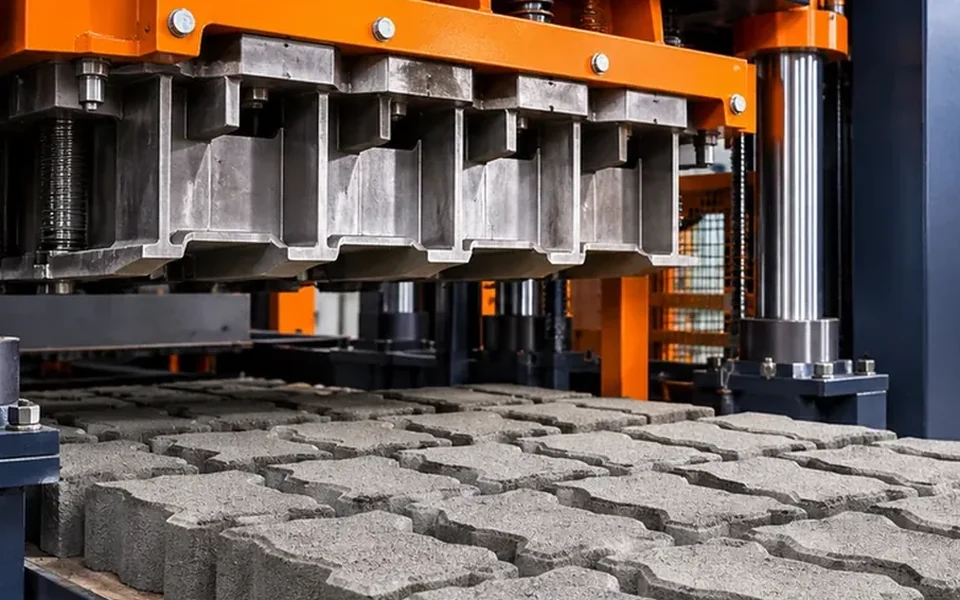
Technical planning for masonry units, pavers, kerbs and specialty concrete product formats.
New product ideas should be translated into measured drawings, practical mould geometry and a production acceptance plan. A drawing that looks attractive may require changes to core shape or wall thickness before it can be formed reliably.
Tooling review covers demoulding, wear surfaces, pallet use, feed volume and safe changeover procedures. Representative samples are useful before a product becomes part of the full production schedule.
A defined development brief avoids ordering tools that are incompatible with the machine or difficult to maintain.
For product & mould development, prepare the operating brief with relevant product types, production hours, available space and any existing machinery that must be considered.
Review production line arrangements or individual equipment categories to prepare your brief.
Translate a market idea into a manufacturable drawing
A market sample, landscape sketch or photograph can begin a new product discussion, but it cannot be used directly as a complete mould specification. Establish finished dimensions, installation function, edge tolerances, thickness, expected aggregate texture and any visual requirements. For hollow masonry units, define internal webs and cavities; for interlocking paving, study joint geometry and the appearance of the assembled pattern. Confirm whether dimensional restrictions come from a recognised local specification or from a particular customer's installation method. Consider realistic handling and packing requirements at the same time, especially for tall or slender products that are vulnerable before curing. Make one controlled drawing the reference for design reviews. If dimensions change, record the revision so that the mould supplier and production team do not work from different versions.
Engineer filling, vibration and release as one problem
A mould is not just a cavity matching the outer shape of a product. Concrete needs to reach corners and narrow zones before vibration and compaction can form a stable fresh unit. Features that look attractive on a CAD model may trap material, cause weak edges or make the product difficult to demould. Review how the feeder distributes concrete across all cavities and whether a face mix, colour layer or unusual aggregate grading changes the process. Deep cores need appropriate support and maintainable connections. Check the interaction of vibration, tamper movement and clearance around raised details rather than assuming that higher force alone will improve forming. Prototype trials should focus on the features most likely to fail. A manufacturable product is one the plant can repeat, not merely one that can be demonstrated once.
Prototype against more than appearance
Evaluation should include actual dimensions, density-related observations, edge integrity, visible texture and stability as the pallet moves away from the press. Sample from several mould cavities to expose inconsistent feeding or alignment. Run a meaningful sequence rather than selecting the first acceptable product after several adjustments. Record material composition, moisture condition, operating settings and the time between forming and inspection so that any improvement can be repeated. For decorative pavers, colour uniformity and face-layer distribution require particular attention. For masonry units, cavity wall integrity and compatibility with installation practice are central. Final strength and durability testing must reflect the target market and agreed curing arrangements. These checks turn a promising design into an evidenced manufacturing process.
Plan tooling wear and revision control early
The expected service life of a mould depends on operating duty, abrasive material, maintenance discipline and the details of its construction. Identify replaceable wear components and the method for restoring damaged edges before production begins. Provide lifting points or tooling arrangements suited to the factory and the mould's actual weight. Keep a revision record connecting the drawing, mould identification, insert dimensions and first-article sample. When a unit is changed for better laying performance or easier forming, the difference should be traceable to a specific tooling revision. Spare cores and wear items may be worth holding when a product is essential to daily sales. A mould maintenance plan also helps explain why two visually similar products can carry different running costs.
Consider package, pallet and downstream restrictions
A successful forming trial does not automatically prove that the product can move through the entire factory. Check its orientation on the production pallet, stability during wet-side transfer, clearance in curing racks and stacking behaviour in a cube. Decorative top surfaces may need additional protection against rubbing or unintended contact. Tall kerbstones and unusual paving shapes can be awkward for grippers designed around rectangular bundles. Packaging materials and transport conditions may impose limits on bundle dimensions or product orientation. If a new mould produces more pieces per pallet, the changed mass and height must be reviewed with the conveyor and curing equipment. The commercial design should account for the finished product leaving the factory in good condition.
Set a clear release procedure for production tooling
Before approving a new mould for routine use, create a first-article review with agreed drawings, operating settings and product acceptance checks. Clarify whether future dimensions, colours and finishes are covered by the current tooling design or require a revised insert. The production team should have a procedure for mounting the mould, checking alignment, cleaning after a run and diagnosing recurring defects. Request documentation of wear limits and service parts where appropriate. Discuss the planned product family in the context of the mould category and the machine selection process. Product development becomes more predictable when tooling engineering, material preparation and downstream handling are reviewed together rather than treated as separate purchases.
Judge commercial feasibility alongside forming feasibility
Not every attractive concrete product is a sound addition to the factory catalogue. A complex shape may require a costly mould, frequent material changes or a low cavity count that reduces daily saleable production. Estimate the minimum sensible batch size for the proposed product and compare it with likely customer orders. If the unit is intended for construction or public infrastructure, establish which market requirements apply before committing to tooling. Consider shipping weight, packaging damage and the availability of installers familiar with the product geometry. Special colours or face finishes can increase cleaning and quality-control effort even when the basic press is unchanged. A useful development review therefore includes customer use, tooling cost, forming reliability, handling risk and the expected price position. The aim is to release a product that works commercially and mechanically, rather than one that merely looks impressive as a single factory sample.