
Approach
Choosing machinery for concrete masonry production should begin with a manufacturing requirement rather than a machine advertisement. Concrete Block Machinery brings together information about block presses, paver machines, kerbstone systems, moulds, mixing equipment and complete production-line layouts. The purpose of the material is to help buyers understand what needs to be specified before comparing configurations or asking for a quotation. A factory making a single hollow block in long production runs will not have the same equipment priorities as a facility changing between coloured pavers, kerbstones and special profiles. Even when two presses appear similar, their usefulness depends on mould geometry, pallet format, material preparation, handling capacity and service access. The equipment is therefore presented as part of an operating factory rather than as an isolated catalogue photograph.
The website is organised to follow a decision in stages. Product categories explain the available manufacturing methods; individual machine pages examine interfaces and operating constraints; production-line pages connect those machines into a workable flow. Technical guides address recurring questions about realistic output, mould compatibility, curing, labour and investment planning. These resources are intended to support better project conversations, not to replace engineering verification for a particular site. Where a number would depend on product dimensions, concrete recipe, operator practice or installed equipment, the content identifies the variables instead of pretending one figure applies to every factory. That distinction matters when a buyer needs to separate a promising concept from a firm contractual performance requirement.
What a complete block production system involves
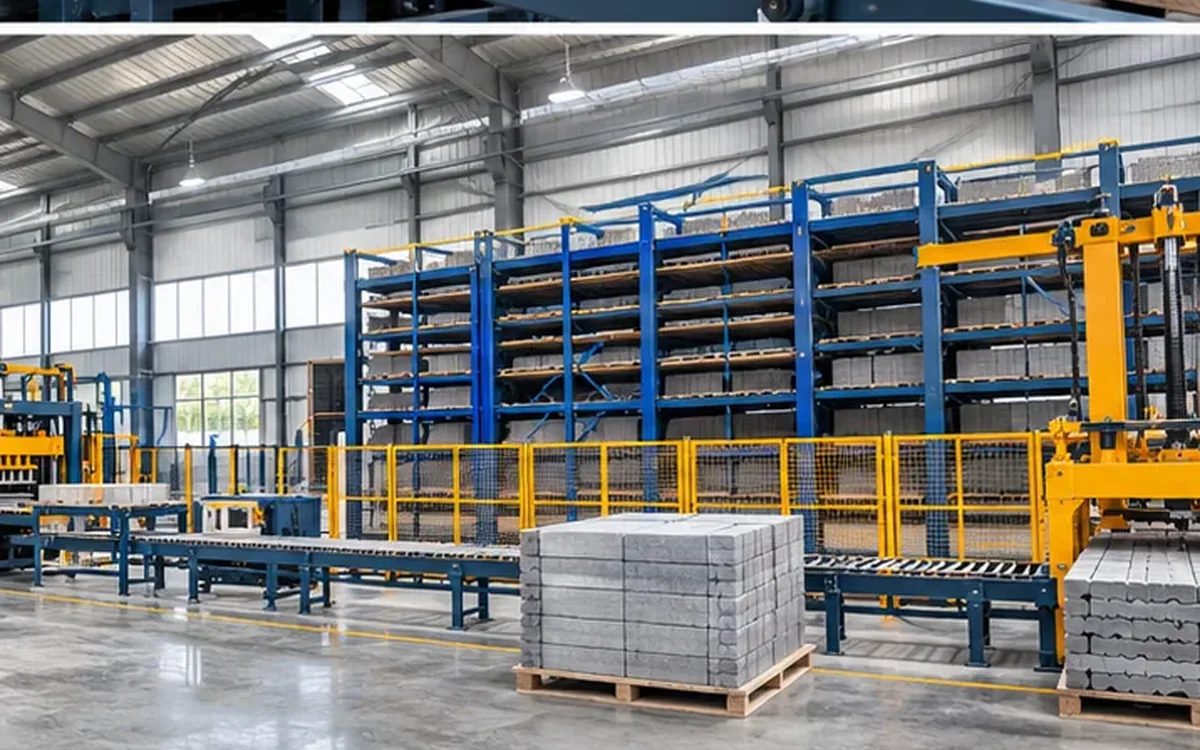
A concrete block factory brings together several processes that must work at compatible rates. Aggregate receipt and storage feed weighing equipment and a mixer, which prepares a consistent dry-cast concrete supply for the forming machine. The press, feed drawer, mould, tamper and production pallet then interact to produce a stable green product. Fresh pallets move through conveyors or elevators into a curing area, where sufficient storage and environmental control allow the product to gain handling strength. Dry-side equipment transfers finished units for inspection, cubing, strapping or wrapping and dispatch. Every transfer point creates an interface that can become a bottleneck or a safety concern if it was not considered during initial planning. A production line should be evaluated by the reliability of this full sequence, not by one isolated cycle-time claim.
Product diversity adds further questions. Coloured face-mix pavers introduce pigment control, cleaning and potential cross-contamination; kerbstones introduce substantial product mass and lifting demands. Hollow masonry units require attention to core alignment and the relationship between aggregate size and thin webs. A buyer may require additional moulds, a different transfer arrangement or more curing inventory long before the main press needs changing. For that reason the complete block production-line overview and block machine category should be read together. A practical equipment proposal needs to identify which functions are included in its scope and which remain part of the customer's building, utilities, site work or operating procedures.
How machinery selection should work
A useful machinery enquiry defines the products first. Finished dimensions, cavity pattern, surface finish, intended tolerance, standards that apply in the destination market and likely mix design provide a much stronger basis for selection than a request for the "fastest" machine. Demand must then be translated into a shift-based production plan, including realistic changeovers, maintenance time, labour availability and the handling steps required after forming. A machine with a high nominal rate may be the wrong purchase if the curing section is undersized or the available floor space forces unsafe material flow. Buyers should compare proposals using a consistent product mix and agreed measures of acceptable output, rather than comparing figures built on different assumptions.
Site conditions deserve the same attention as headline machine capabilities. Available electrical supply and voltage, water quality, compressed air, foundation design, building height, raw-material delivery routes and maintenance access can affect both the configuration and the installation schedule. Existing equipment may be useful, but only after its capacity, interface and service condition are checked. Mould changes should be evaluated for the actual product programme: frequent short runs reward a different workflow from long campaigns of a single unit. Our machine selection guide and machine and mould planning pages describe these questions more closely. The correct answer is usually the configuration that serves the products and factory flow reliably, not the one with the most impressive brochure label.
Technical transparency and verified specifications
Public machinery descriptions can help explain engineering concepts without making promises about an unconfirmed final installation. Concrete output depends on the mould configuration, cycle sequence, concrete characteristics, line availability and acceptance criteria. Motor power, hydraulic arrangements and pallet sizes also vary by equipment class and selected options. When these values have not been verified for a specific offered machine, this site avoids presenting invented figures as an equipment specification. Illustrative machinery and plant photographs are used to explain processes and may not depict a particular purchasable model. Product-specific guarantees, drawings and acceptance values require confirmation in a formal technical proposal before a commercial commitment is made.
Documentation is an important part of that verification. Buyers should ask for machine layouts, utility loads, equipment boundaries, basic control architecture, safety information, recommended spares and a description of the proposed acceptance tests. Requests for unusual product profiles should include drawings and sample requirements rather than rely on a catalogue image. Documentation should also distinguish supplier-delivered items from site work such as foundations, buildings, electrical distribution and ventilation. These details make quotations more comparable and reduce ambiguity when equipment arrives. The website's information is designed to encourage that level of clarity, rather than implying that all machinery configurations share one fixed list of components or one guaranteed output.
Operating life, maintenance and future growth
Buying equipment is only the beginning of a production programme. Wear components, hydraulic circuits, electrical diagnostics, pallets, mould surfaces, conveyor chains and curing equipment all need access and a documented inspection routine. A layout that forces maintenance staff to work around blocked aisles or remove major guards for routine work can create years of avoidable downtime. Spare-parts planning should identify critical components and realistic replacement lead times. Training should explain both normal process adjustments and safe recovery when a pallet jams, a mould is not seated correctly or a sensor indicates an unexpected state. The maintenance and spare-part planning resource describes why these requirements belong in the purchase decision, not only in after-sales paperwork.
Future expansion should be described realistically. A factory may begin with a limited product range and later add face-mix dosing, faster handling, more mould families or additional curing storage. The initial plant plan can preserve routes and interfaces for such options, but it should not promise that every later addition will be a simple plug-in upgrade. Mechanical envelope, available utilities, controller capacity, floor loading and process timing must all be checked when the product programme changes. Expansion value comes from planning the interfaces early, not buying unused complexity on the assumption that it will eventually be needed. This approach supports a project that is serviceable at launch and still understandable when business requirements evolve.
How to use this website effectively
If the planned product is already defined, begin with the machine catalogue and the category that matches its manufacturing method. Use the related production-line pages to understand what else is needed beyond the press, and read the technical guides for questions about output calculations, pallet requirements or curing strategy. If the investment is at concept stage, the production-line catalogue provides a better starting point because it shows how material preparation, forming, curing and packing must be balanced. The engineering solutions section is useful when the main uncertainty concerns a plant layout, mould interface, automation route or service plan rather than a named machine.
An effective first contact does not need a perfect engineering specification. A concise summary of the desired products, target market, likely shift pattern, available site and preferred degree of automation is enough to identify the important unanswered questions. Drawings, photographs or an existing line diagram may be added where available, but avoid sending confidential or personal information unless it is necessary for the enquiry. The contact page can be used to describe that scope. Any subsequent quotation should confirm the exact proposed equipment, responsibilities, performance assumptions and project requirements separately. The site is a starting point for informed decisions and a clearer industrial conversation, not a substitute for a site survey or contracted engineering documentation.