
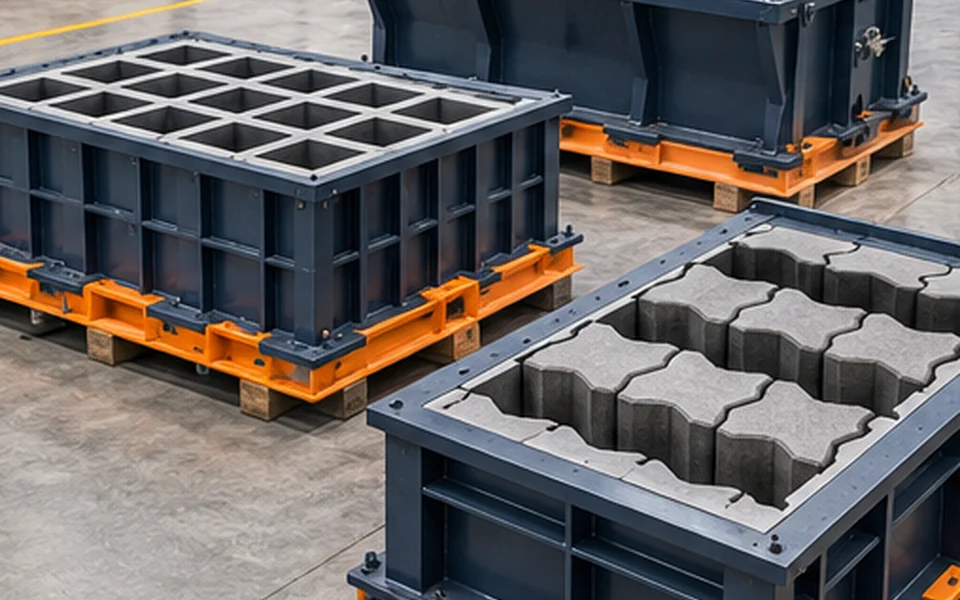
Matching product geometry and manufacturing demand to an appropriate press and mould configuration.
A suitable machine is defined by what the customer will actually produce. Product dimensions, wall sections, surface expectations and changeover frequency are more useful than choosing only by the largest advertised capacity.
The selection process reviews pallet dimensions, mould cavity layout, filling behaviour, vibration and tamper requirements, and practical output per shift. It also identifies the neighbouring equipment the machine will need.
This approach reduces the chance of selecting a powerful machine that is poorly suited to the planned product portfolio.
For machine & mould selection, prepare the operating brief with relevant product types, production hours, available space and any existing machinery that must be considered.
Review production line arrangements or individual equipment categories to prepare your brief.
Start with drawings that expose the difficult geometry
A description such as “standard hollow block” is not enough to select tooling. Supply the finished length, width and height, core openings, web thickness, corner detail and any special face or interlock requirements. Identify which dimensions are governed by the local product specification and which may change during market development. Deep cavities, narrow ribs and abrupt changes in wall section can affect filling and demoulding differently from a solid rectangular product. A buyer should ask for evidence using challenging representative units, not only samples selected because they are easy to form. For pavers, include surface appearance and edge geometry alongside dimensional accuracy. Put these drawings at the centre of the selection conversation; machine class names become meaningful only when they can be assessed against the intended product range.
Check the entire machine–mould interface
Compatibility extends beyond overall mould length and width. Verify tamper-head alignment, support points, mounting holes, stroke, filling height, pallet flatness and the equipment needed to remove and refit the set safely. A mould that can be bolted into a frame may still produce uneven density if its feed arrangement or vibration response is unsuitable. Discuss how wear components are adjusted, what tolerances are used in replacement parts and how cores are supported during repeated service. Mould weight affects changeover tooling and lifting requirements, while product height influences handling downstream. If existing moulds are expected to be reused, ask for dimensional verification before pricing their adaptation. Machine and tooling should be specified as a functional set instead of two unrelated catalogue purchases.
Compare products per pallet without hiding quality trade-offs
The number of pieces per pallet is only one element of throughput. A crowded layout can increase mould output while leaving too little room for stable forming, clean demoulding or reliable transfer. Compare cavity arrangement using the same drawing and the same finished-product quality criteria for each candidate. Consider the weight carried by the pallet and whether it stays sufficiently flat throughout vibration and wet-side transport. Check whether the factory needs frequent changes between two cavity layouts and how much production time is lost when a mould is cleaned or switched. A higher theoretical count is useful only when the complete process can make and cure saleable units. Review the production pallet size guide before treating pallet footprint as a small accessory detail.
Define the material and forming tests that matter
Dry-cast mix consistency influences whether narrow mould features fill and whether a green unit can survive transfer. Agree on the source aggregate grading, moisture control approach and any face mix or pigment requirements before comparison testing. Ask the supplier to demonstrate settings for representative products and document the adjustments between runs. Evaluate units from the whole mould, not a hand-picked corner, and record whether defects repeat at the same cavity. Check product dimensions, exposed surfaces, sharpness of corners and stability after demoulding. Later strength and durability testing should follow the applicable local market requirements and agreed curing method. The selection result should include a known process window, not only a visual impression from a brief demonstration.
Plan tooling maintenance and future product additions
Product range expansion can require more than a second mould. A thicker paving unit may change pallet loading, while a taller block may exceed the practical travel envelope of a press or downstream transfer. Determine the format limits of the proposed machine and write down which dimensions are fixed and which can be adjusted. For mould servicing, identify removable cores, wear liners, edge repairs and the ability to hold spare tooling without damaging reference surfaces. A changeover schedule should include lifting, alignment, cleaning, first-article checks and the time needed to return to stable production. Ask how mould part identification and revision control will be maintained when several similar products are in use. Without a disciplined tool register, small modifications can become hard to trace after the plant has been operating for a year.
Use a comparison sheet built around production decisions
Give each bidder the same drawings, target shift schedule, expected product mix and a short list of must-have features. Request the proposed mould footprint, useful product-height range, interface drawings, feed-system details and controls needed for recipe changeovers. Have the bidder state which sample products and acceptance checks form part of their offer. Ask separately for the machine, tooling, pallet supply and supporting line equipment to expose scope differences. Service access, changeover effort and spare-part support should be judged alongside the offered purchase price. The block machine category and mould category provide related configuration context. A good decision makes the plant's product requirements testable before a purchase commitment is signed.
Resolve the acceptance question before commercial negotiation
Machine and tooling offers should specify who supplies trial concrete, reference drawings, production pallets and sample inspection instruments. A buyer can otherwise receive a successful demonstration that is difficult to reproduce at the destination factory. Agree on acceptable dimensional outcomes for the intended products and identify the observations that will trigger further adjustment. Include trial changeover time where multiple product families are central to the purchase. Document whether the proposed feeder, tamper and mould are part of the quoted scope and which spare tooling is recommended for initial operation. Ask how product revisions will be evaluated after purchase and whether a different pallet format would affect the accepted interface. A transparent acceptance basis helps the owner compare different combinations fairly and protects the supplier from demands that were never included in the agreed design. It also gives commissioning teams a practical reference when the factory begins real production.