
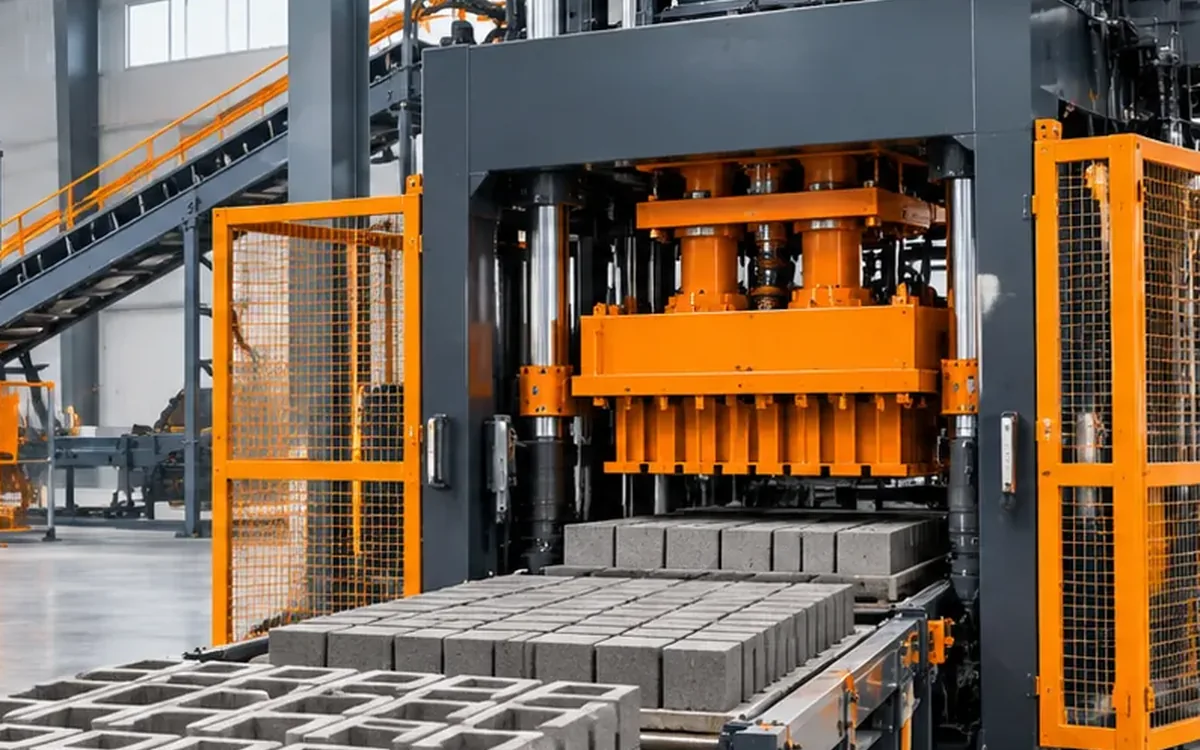
Line concept
A complete block plant should be planned as a connected industrial process rather than a collection of individually selected machines.
The flow begins with aggregate storage and controlled dosing, moves through mixing and machine feeding, then forms units onto pallets. A green-product transfer system takes those pallets to curing. Cured units are later separated from production pallets, cubed, and prepared for dispatch.
Process flow and capacity balance
The press, mixer and curing storage should be matched using a common production scenario. If a press is rated at a theoretical peak but the curing area cannot accept that flow, the line will not sustain the claimed output.
Scope for project planning
Confirm plant footprint, truck movements, utility access, waste and wash-down arrangements, spare parts and operator safety as one layout. This avoids expensive downstream redesigns.
Explore machinery options and engineering support topics before requesting a proposal.
Material preparation and plant balance
Aggregate delivery should be separated from the finished-product dispatch route wherever site constraints permit. Moisture-sensitive materials need storage and feeding arrangements that support a repeatable mix. Link batching and mixer working sizes to the mould fill requirement; when the concrete supply is intermittent, the press waits and the nominal machine capacity becomes irrelevant.
Green product and curing logistics
Plan the complete movement from the forming pallet through transfer equipment to racks or an appropriate curing arrangement. Calculate occupied rack positions from the planned pallet arrival rate and required dwell period. The return flow of empty production pallets must be reliable, and there should be space to divert a damaged board before it reaches the press.
Acceptance plan for the integrated factory
An integrated line should be commissioned with the intended block geometry and a normal shift sequence. Record mix consistency, mould release, transfer damage, curing allocation and the actual number of accepted units reaching dispatch. Agree on utility connections, safety interfaces, maintenance boundaries and training responsibilities before equipment delivery.
Related machinery: Examine the Industrial Automatic Concrete Block Machine as one possible equipment element, then request a project review with factory dimensions and target product drawings.
', `image_path`='assets/images/cbm-complete-block-plant.webp', `image_alt`='Concept visual illustrating Complete Concrete Block Production LineDefine the factory from finished-block demand
The starting point for a complete plant is the mix of finished concrete units the business expects to sell, not the largest nominal output shown for the forming press. Translate product drawings and monthly demand into mould campaigns, pallet counts and realistic working shifts. Include seasonal variation, planned cleaning and the labour available for tool changes. A factory designed solely for one hollow block may not accommodate later kerbstones or alternative pallet formats without significant changes. Establish the likely product portfolio before deciding where mixers, curing racks and finished-goods storage will be placed. The result should be a production duty document that can be tested against every proposed equipment section. This approach also clarifies whether the project needs a fully automatic line at the outset or can develop through well-defined phases.
Aggregate delivery should be separated from finished-product dispatch where the site allows it. The receiving zone needs suitable access to bins or covered stockpiles, with practical space to check grading and moisture. A batching system then weighs material to a defined recipe and delivers it to the mixer. The mixer should supply low-slump concrete at a rhythm compatible with the press without leaving material waiting too long in transfer hoppers. Design a path that prevents material segregation and allows safe cleaning of belts, gates and discharge equipment. Where mixers and presses have different control suppliers, agree on full and ready signals before installation. A functional layout avoids placing the process-critical mixer in a location that is difficult to inspect or impossible to service without interrupting the whole factory.
Balance forming output with wet-side logistics
A block press should be evaluated alongside the capacity of pallet feed, exit conveyor, fresh-product elevator and curing storage. The limiting element may be the rate at which new pallets can be positioned or full racks can be accepted, even when the press itself could form faster. Establish pallet dimensions and loads for the heaviest required product. Follow the green block from release through every roller, transfer and lifting movement; harsh handling can create rejected product before curing begins. Set aside positions for inspection and safe recovery of a misplaced pallet. The control system should stop upstream movements predictably when the receiving section is occupied. This is a more useful measure of line capability than a press-only cycle claim.
Curing space is the largest hidden stock area in many block factories. Calculate the number of pallets simultaneously occupying curing positions from the forming rhythm and the curing period appropriate for the selected mix and exposure conditions. Include changes in shift pattern, product height and rack load. Where a shared curing zone handles several products, agree on batch identification and withdrawal sequence so units are not sent to cubing prematurely. The design should state how racks are loaded, how environmental conditions are managed and who checks product readiness. A useful layout provides access for inspection and safe work without disrupting pallet circulation. Curing performance must ultimately be verified by the product testing and quality requirements of the destination market.
Connect dry-side cubing with transport needs
After curing, products move through a lowerator or equivalent retrieval station into inspection and cubing. The cubing system needs a layer pattern and gripping arrangement suitable for the blocks actually manufactured. Consider whether the business sells whole packages, mixed assortments or unusual unit sizes. The factory must provide staging for completed loads, pallet returns, damaged units and forklift movement without congesting the fresh-product route. Packaging should protect the product during the expected loading, storage and delivery conditions. A reliable dry side needs sufficient operating capacity to clear curing storage before the next batch is ready. Observe a complete stack and discharge cycle during acceptance, not only the speed of a gripper operating without products.
Separate machine demonstrations are not a substitute for an integrated acceptance test. Prepare a staged procedure that checks dosing and mixing, forming quality, wet transfer, rack management, dry-side retrieval and safe pallet return. Test a product change and a controlled restart after downstream blockage so the interface logic is visible. Record cycle times, material condition, quality checks, operator interventions and reasons for stoppage without claiming that the first commissioning shift represents mature plant output. Electrical, hydraulic and mechanical responsibilities must be assigned before the site test. Confirm operator training and restoration of control backups, and document open issues with owners and acceptance criteria. A full-line review is the best defence against gaps between equipment supplied by different parties.
Request an equipment boundary that is easy to price
For a complete plant quotation, provide expected product drawings, shift schedules, site plan, utility supply, aggregate sources and finished-package format. Identify any existing machinery, building works and storage areas that will remain in use. Ask for a diagram marking exactly which equipment and services the proposed price includes, from bins to finished stacks. Include spare pallets, initial tooling, safety fencing, installation supervision, training and documentation in the discussion. Define realistic acceptance conditions and how final product testing will be completed. To study individual interfaces, see the automatic block press, batching unit and curing pallet circulation. Those components only deliver a dependable plant when planned as one sequence.