
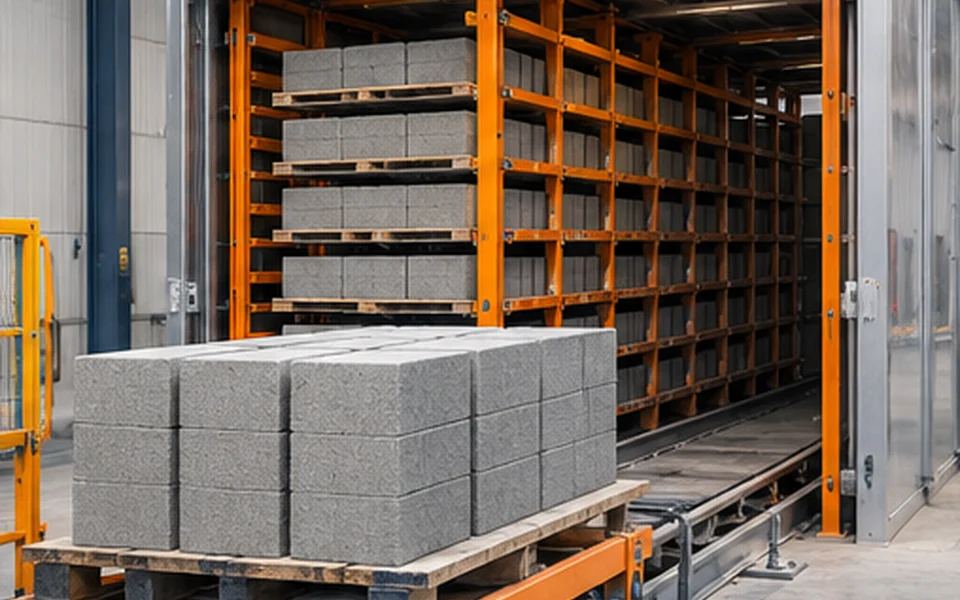
Equipment application
Curing storage should be sized around the maximum number of pallets produced before the first cured pallets return. Room temperature and moisture control influence the time products occupy storage.
Transfer, storage and product protection
A rack system has to carry the loaded pallets safely, enable reliable transfer and provide access for inspection and maintenance.
Operating the connected production process
Effective pallet circulation reduces idle pallets and transfer interruptions. The design must consider pallet condition, cleaning and integration with lowerators or unloading stations.
Requesting a practical equipment specification
State the proposed shift length, curing method and cycle assumptions so rack quantity can be evaluated using realistic throughput rather than peak machine speed.
- Production pallet dimensions and load
- Fresh vs cured product handling
- Rack and transfer compatibility
- Fault recovery and maintenance access
To plan curing rack and pallet circulation system within a complete plant, see the machinery category and the connected production line options.
Storage volume follows actual production flow
Curing racks need enough positions for the intended dwell period and daily output. Count loaded pallets in the forming cycle, the time they occupy racks and the delay before they can return to the press. A high-cycle machine with too few free pallets or rack slots will stop even when the forming station itself is operating correctly.
Supporting uniform curing
Curing strategy depends on concrete composition, ambient conditions and the applicable quality requirements. Rack arrangement should allow controlled movement without exposing fresh units to rough handling. Where accelerated curing is considered, evaluate temperature and moisture uniformity and the effect on the final product rather than assuming faster turnover is always beneficial.
Pallet lifecycle and damage prevention
Production pallets move repeatedly through filling, compaction, curing transfer, stripping and return. Identify inspection points for damaged boards, uneven supports and buildup that can alter block dimensions. The rack, finger car and return conveyors should handle the actual loaded mass and pallet geometry with a clear path for removing a defective pallet.
Sizing rack positions from a real shift plan
Curing capacity follows the number of loaded pallets produced and the time they occupy storage. Calculate the arrival rate for each common product and build the daily storage requirement around the selected curing method. Add realistic handling, loading and unloading intervals instead of assuming every position becomes free at the exact moment the press needs it. A rack system that appears generous for one product may be restrictive for taller units or longer dwell times. Include the effect of weekends, batch separation and planned maintenance in the calculation. The purpose is to give forming equipment a stable destination for green products while maintaining safe aisle access for the transfer system.
Product conditions during early strength development
Concrete gains properties over time, and the relevant curing conditions depend on mix design and product specification. Plan how temperature and moisture are managed or monitored in the chosen curing environment. Uneven exposure can produce variability between pallet positions even if forming conditions are stable. Different products or colours may need separate identification and traceability. Avoid treating a universal storage duration as a guarantee that units are ready for cubing. The production system should support sampling and quality verification at agreed stages before products are handled more aggressively. Proper curing organisation connects product performance, inventory control and the available circulation space in one operational plan.
How production pallets circulate back to forming
Once products are suitable for removal, the empty pallet must return to the press in a predictable condition. Plan the route through cubing, inspection, cleaning, accumulation and loading into the machine's pallet magazine. Bent or contaminated pallets can affect mould alignment and cause defects on subsequent cycles. Establish an inspection point and a quarantine area for damaged units rather than allowing every pallet back into circulation. The size of the pallet fleet should reflect dwell time, transfer queues and maintenance reserves. A factory with too few usable pallets can be stopped by a shortage at the press even while the forming machine itself is operational.
Rack geometry and transfer compatibility
Before choosing rack format, confirm pallet footprint, loaded product height, allowable load and required insertion clearances. Compare these values with the elevator, finger car or other transfer equipment proposed for the plant. Small geometric mismatches can create repeated alignment faults, particularly when pallets vary in thickness or condition. Include the turning and maintenance space needed around the racks as well as emergency access requirements. A rack's total nominal positions do not equal usable capacity if some lanes cannot be reached safely by the intended transport arrangement. Test the actual movement of loaded pallets with representative tall and heavy products during commissioning.
Traceability and mixed-product storage
Many factories produce different blocks, pavers or colours on adjacent days. Mark curing loads by product, production time and batch so the dry-side operation knows when each group is ready. A clear storage map reduces the risk of premature cubing and mixed orders. Where racks are filled automatically, determine how the control system identifies occupied locations and recovers after a stop or manual intervention. Staff should also be able to locate quality samples without blocking equipment routes. Inventory status has to reflect both physical positions and curing readiness, since a full rack is not necessarily a full inventory of dispatchable products.
Acceptance and maintenance of the circulation system
Observe a complete pallet cycle from the forming station through curing transfer, dry-side separation and return to the press. Record misalignment, collisions, abnormal noise and any product contact during normal movement. Inspect rack supports, guides and pallets for wear and deformation and define periodic checks appropriate to the expected load. The project quotation should specify the included rack positions, transfer devices, pallet inventory and automation interfaces. Confirm civil works and floor loading responsibilities before delivery. The practical success criterion is a safe, repeatable circulation loop that supports the production programme, not simply a storage-rack count printed in a catalogue.
System integration: Curing racks and pallet circulation determine how long fresh products can remain undisturbed without restricting the press. Storage capacity should reflect the product mix and practical curing time, while empty pallets must return in a predictable condition. The automatic curing and cubing overview sets out how racks, elevators and dry-side transfers interact. A quotation should identify the total pallet inventory, rack configuration, floor space, handling method and service routes rather than offering rack count alone.