
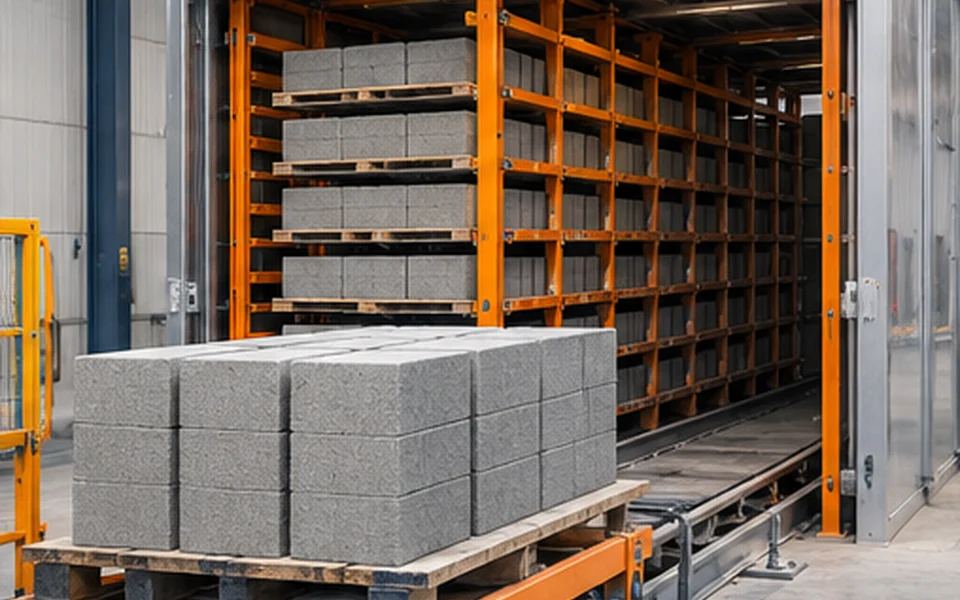
Line concept
An automatic curing and cubing line sits between the block press and the finished-goods yard. Its main purpose is to prevent handling from interrupting steady production.
Fresh pallets move through suitable transfers to a defined curing method. After strength development, dry-side equipment returns pallets and passes products to cubing and packaging.
Process flow and capacity balance
Rack quantities, pallet types and transfer distances should be based on shift production and curing residence time. Control integration must coordinate machine demand, transfers and fault recovery.
Scope for project planning
Good layouts include maintenance access and a way to isolate a station without creating an unsafe backlog of pallets.
Explore machinery options and engineering support topics before requesting a proposal.
Rack turnover and finished-product quality
Curing and cubing equipment must be matched to the actual rate of accepted green pallets and the duration they remain in controlled storage. Calculate the maximum number of occupied rack positions and how quickly production pallets can be returned after units are stripped. A shortage of clean empty pallets can stop the press even when the cuber is ready.
Gripper design and pack format
The cured product must withstand handling without chipped edges or cracked webs. Verify grip-contact surfaces, bundle patterns, wrapping method and transport-pallet dimensions with real samples. When multiple product sizes share the line, identify the adjustments needed for each and whether automatic changeover is essential.
Recovery and safeguards
An effective automation proposal must show what happens when a pallet is misplaced, a rack position is unavailable or a layer cannot be picked. Operators need safe access and clear fault information rather than a restart procedure based on guesswork. Review sensor placement, isolation points and the service approach for transfer and stacking equipment.
Related machinery: Examine the Automatic Block Cubing and Packing Station as one possible equipment element, then request a project review with factory dimensions and target product drawings.
', `image_path`='assets/images/cbm-curing-handling-plant.webp', `image_alt`='Concept visual illustrating Automatic Curing and Cubing LineBegin with the press output and curing requirement
An automatic curing and cubing system must accept the actual number of loaded production pallets formed during a working shift. Determine pallet dimensions, maximum unit weight, product heights and likely variation in the forming schedule. Then establish the curing period needed before dry-side handling for the proposed concrete mix and local conditions. A nominal rack count is meaningful only when those physical and time assumptions are stated. Estimate the number of pallets in the wet-side elevator, rack store, dry-side lowerator and return path at any given time. Leave margin for normal pauses and inspection, but avoid treating an arbitrary larger rack as the only solution to production instability. The goal is steady product flow without press stoppage or premature release from curing.
Fresh blocks and pavers are susceptible to distortion and edge damage. A wet-side line needs properly aligned transfers, controlled acceleration and receiving points designed for the loaded pallet. Check the effect of the tallest and heaviest proposed units on elevator clearance and lift capacity. Sensors should confirm that a rack position is free before the next pallet advances. If a pallet arrives out of alignment, the line needs a safe stop and recovery method rather than forceful continued movement. During acceptance, inspect products from multiple pallet positions after transfer and compare them with blocks taken directly from the press. This helps distinguish forming defects from handling damage and prevents the factory from changing concrete recipes to compensate for rough mechanical transport.
Maintain lot identity in curing storage
A curing store contains work in progress whose condition and release time need to be known. The operating sequence should preserve the identity of batches or product groups well enough to avoid mixing fresh and ready stock. Different thicknesses, colours or recipes may need different handling and inspection timing. The design should identify where curing conditions are monitored and how staff respond to deviations. Where there are several racks, sequence control should prevent a recently filled position being unloaded before the product is ready. Access for inspection and safe maintenance is essential, particularly in systems with moving rack equipment. Curing should be treated as a controlled process and inventory stage rather than a passive place to park pallets.
The cubing station should reproduce the package arrangement expected by customers, transporters and distributors. Define layer counts, stack dimensions, preferred handling direction and whether units are gripped directly or with an attachment. Long kerbstones, delicate decorative pavers and hollow blocks may demand different grip surfaces or patterns. An adjustable machine is useful only if the proposed full set of products can be handled within the actual mechanical and control limits. Ask to see products moved through the complete cycle, including release onto the shipping pallet or stacking conveyor. Test for chipped edges, distorted stacks and incomplete layers. The chosen packaging method and forklift pick-up direction must fit the dispatch yard, not merely the dimensions of the cubing robot.
Include production pallet inspection and return
Once finished products leave the pallet, the empty pallet must return reliably to the forming press. The return conveyor may need turning, stacking, cleaning or a check for damaged units. A warped pallet can affect later product geometry, while a missing pallet will interrupt the forming cycle. Set out how unsuitable pallets are removed and how reserve stock is introduced without unsafe work. Consider the total circulating inventory when curing cycles are extended or when the cubing area stops. The return loop should not cross the finished-product forklift route without a deliberate access and safety plan. Reliable pallet management is a hidden but significant part of line productivity, since the press cannot form a new batch without the correct support underneath it.
Automatic transfer and cubing equipment combines moving loads, sensors and sequencing logic. The acceptance plan should deliberately test occupied positions, missing pallets, incomplete layers and controlled stoppage of the dry side. Ask how the line re-establishes its physical position before restarting and which recovery actions are restricted to trained staff. Verify mechanical guards and machine safety systems against the applicable requirements; ordinary HMI warnings do not replace protective measures. Observe whether a partially clamped layer is held or released safely when a fault occurs. Document who may change cubing patterns and which checks follow a software revision. This matters because a fast system that cannot recover cleanly from routine exceptions can cause serious production delays.
Measure downstream performance through finished packs
A practical trial should record intact pallets accepted from the press, controlled cure and completed packages released to dispatch. Track damaged units and reasons for line stops separately to identify whether the loss occurs at the wet side, storage, cubing or return section. Check the cycle time for different package patterns rather than using a single unloaded demonstration. The proposal should state maximum pallet loads, rack compatibility, handling limits, installation interfaces and responsibilities for training. Quality and batch release must remain linked to the concrete product requirements of the destination market. For component details, compare the fresh-block elevator, curing rack system and automatic cubing station. Those functions should be engineered as one complete downstream route.