
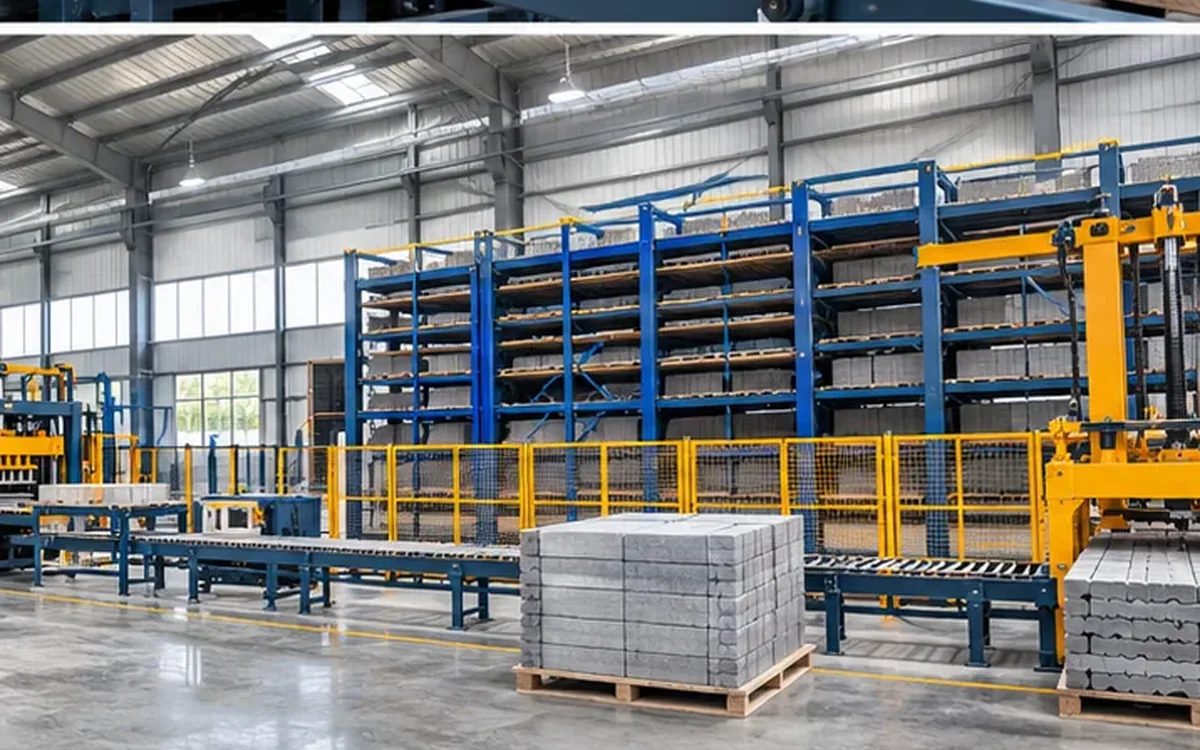
Equipment application
Cubing and packing equipment converts cured blocks into stable transport units. Different block sizes and stacking patterns demand suitable gripping and placement routines.
Transfer, storage and product protection
The handling process must work around product strength, stack height, pallet type and loading method. Packaging may include strapping or wrapping subject to local dispatch requirements.
Operating the connected production process
The end-of-line station can limit production if its cycle or storage area is inadequate, so capacity calculations should include peak stacking demand and changeover time.
Requesting a practical equipment specification
Provide final block sizes, desired cube dimensions, load transport method and packaging requirements for a configuration review.
- Production pallet dimensions and load
- Fresh vs cured product handling
- Rack and transfer compatibility
- Fault recovery and maintenance access
To plan automatic block cubing and packing station within a complete plant, see the machinery category and the connected production line options.
Finished product and layer stability
Cubing begins only after the product has sufficient strength to tolerate gripping, lifting and stacking. The gripper concept must match block geometry, contact surfaces and the required bundle layout. A paver line may need a different layer pattern from hollow masonry blocks, particularly when the customer expects pallets compatible with a specific unloading method.
Palletizing and wrapping decisions
Decide whether finished units are shipped on pallets, banded bundles or another approved arrangement. Verify stack height, corner protection, wrap tension, load dimensions and access for forklifts. Poor packaging can undo the benefits of a well-controlled forming process by producing chipped edges or unstable loads during transportation.
Automation safeguards and fault recovery
Cubing equipment should include safe boundaries and a documented method for clearing misaligned layers or failed picks. Ask how the process detects missing products, uneven stack heights and other typical faults. The required throughput should account for rejected layers, package changes and real dispatch patterns rather than only the fastest robot motion.
Starting with cured product condition
A cubing station should receive units that have developed adequate strength for gripping, lifting and stacking. The appropriate readiness is determined by the product specification and process, not simply the number of hours after forming. Distinguish blocks, thick pavers and fragile decorative units because their stacking and contact surfaces may differ. Before designing the gripper, document piece dimensions, layer pattern, product weight and allowed contact points. Some products may require separators or a different orientation. Inspect edges after each handling stage in a trial. A cuber that moves pallets efficiently but chips finished products does not deliver acceptable dispatch performance.
Layer formation and gripping strategies
The gripper, layer-forming conveyor and receiving pallet should be configured for the actual range of products. Review whether layers are prepared by aligned rows, mechanical grouping or another method suited to the unit geometry. Uneven pieces or protruding profiles can create unstable stacks when pressure is applied at the wrong location. Test the heaviest, lightest and most easily damaged products in the range. A layer arrangement should remain stable while the stack is moved by forklift and transported to site. Discuss how any change in block length or paver thickness affects the gripping elements, stacking programme and the need for operator adjustment.
Packaging choices for transport conditions
Wrapping and strapping methods should be selected around the product's weight, pallet stability and expected shipping route. A short local delivery may have different exposure and handling conditions from an export shipment with repeated transfers. Consider whether the product needs protective sheets, corner protection or measures to reduce surface abrasion. Packaging equipment should not conceal damaged units or interfere with visual quality checks. Mark product type, batch and quantity so order picking does not mix similar products. The proposal should clarify which wrapping, strapping and label systems are included; a cubing machine does not automatically include every possible packaging stage.
Balancing the dry side with curing output
Cubing capacity should be compared with the actual rate of pallets becoming available after curing. A station that handles one standard layer quickly may slow down for taller stacks, different product patterns or frequent package changes. Model forklift departures and receiving pallet supply as part of the cycle. Determine how the line responds if finished-product transport is delayed and whether a temporary buffer is required. It is equally important to understand how empty production pallets return to the forming machine. Dry-side delays can eventually stop the wet side when the pallet inventory is exhausted. The factory layout should therefore connect curing readiness, cubing rhythm and pallet circulation rather than treating each as separate machinery.
Guarding, fault states and operator interaction
Automatic lifting and clamping create hazards that require well-defined operating boundaries. Ask how the station detects missing products, an incomplete layer or an out-of-position receiving pallet. Safe recovery after an interrupted grip should be tested with representative loads, not explained only in theory. Operators need clear visibility of the active programme and a controlled method for selecting a new product pattern. Maintenance access to belts, clamping elements, sensors and moving frames must be part of the installation plan. A supervised manual mode should not create an uncontrolled restart risk. Well-designed interfaces improve uptime by allowing staff to distinguish a genuine mechanical fault from an easily corrected feeding issue.
Acceptance test and project information
Provide drawings of the finished units, layer patterns, intended package sizes, pallet types and expected dispatch frequency. State whether coloured or surface-finished products need extra handling protection. During an acceptance run, record product damage, stack stability, packaging consumption, operator interventions and the flow of returned production pallets. Confirm the dimensions and orientation of forklift pick-up positions and any building-height constraints. Request a scope table covering grippers, conveyors, stack formation, wrapping, electrical controls and installation. This makes it possible to evaluate the station as a finished-product logistics system rather than assuming that high nominal stacking speed guarantees dependable shipping.
System integration: Cubing equipment should be selected around the dimensions, weight and package pattern of the cured blocks, with attention to pallet and forklift access. A unit that stacks one standard product well may need different gripping or support for a varied product mix. The curing and cubing line shows how dry-side transfer and pack formation depend on upstream pallet movement. Supply expected product families, bundle layouts, strapping needs and dispatch constraints in the project scope so the packing concept can be checked against real shipping requirements.