
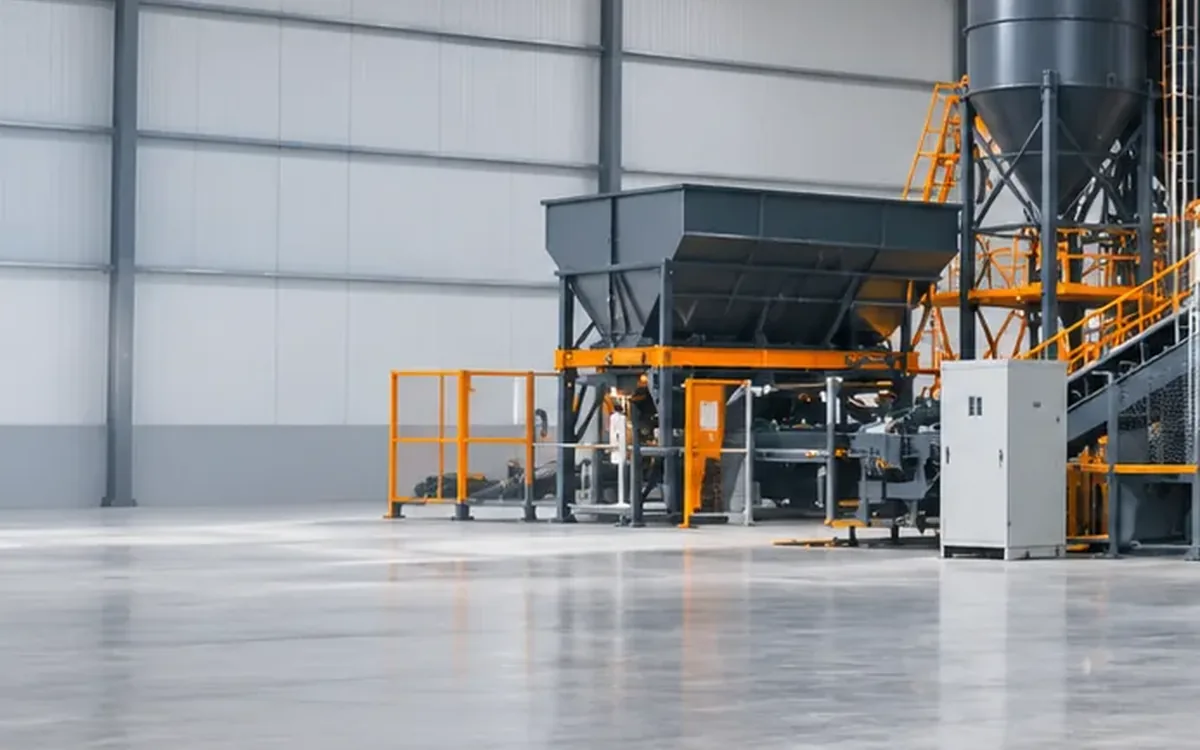
Line concept
Multi-product plants seek flexibility across blocks, pavers and infrastructure units without allowing constant changeovers to consume all working hours.
Mould scheduling, product-specific feed requirements and pallet handling should be designed together. Kerbstones may be much heavier than pavers, and special products can require distinct curing and stacking patterns.
Process flow and capacity balance
The project plan should identify which products dominate daily demand and which are manufactured in shorter runs. Separate colour or face-mix requirements may justify additional mixing capacity.
Scope for project planning
A practical quotation includes a proposed production schedule, mould handling strategy and the extent of automation desired across each product changeover.
Explore machinery options and engineering support topics before requesting a proposal.
Balancing dissimilar product families
An integrated plant can be attractive where demand shifts among masonry blocks, paving units and heavier kerbstones. These products can require different mix settings, mould heights, compaction behaviour and finished-product handling. Prepare a production calendar that groups compatible runs and quantifies the cost of moving between the product families.
Tooling, storage and material routing
The plant needs orderly mould storage, safe lifting arrangements and enough access to clean the feeder or change recipes. Heavy kerbstones may need different transfer supports, while decorative pavers can require more careful face handling. The layout should identify which pathways are shared and which equipment must be dedicated to a particular product.
Evaluating flexibility without assuming peak output
Compare planned monthly sales quantities with a feasible shift schedule that includes actual changeover and cleaning time. Review both the heaviest single-product day and the most varied day. A configuration that is less aggressive on peak cycle speed may be more robust when it preserves consistent quality and fewer interruptions across the mixed programme.
Related machinery: Examine the Flexible Paver and Block Production Press as one possible equipment element, then request a project review with factory dimensions and target product drawings.
', `image_path`='assets/images/cbm-hero-industrial-block-factory.webp', `image_alt`='Concept visual illustrating Integrated Block, Paver and Kerbstone PlantBalance three product families without treating them as identical
A multi-product block plant is a scheduling problem as much as an equipment purchase. Hollow blocks, interlocking pavers and heavy kerbstones need different mould geometry, mixing decisions, pallet loads and handling routines. Begin with a realistic production calendar showing how much of the month each family will occupy. If a plant sells short campaigns of speciality items, changeover effort may consume a significant part of its available shifts. Establish which products share the same pallet envelope and which require special rack clearances or dry-side gripping. A combined machine catalogue does not prove that every format can run profitably on one line. The investment decision should be based on the combined operating programme and its bottlenecks rather than a theoretical list of supported products.
Different block, paver and kerb products may use distinct aggregate grading, water demand, pigments and surface requirements. The batching system needs enough storage and recipe control to keep these materials traceable. Discuss whether face-mix paving is part of the plan, because this could call for a second preparation route or dedicated cleaning procedures. Record the time required to remove residue from mixers and feeders when switching between colours or mixtures. A changeover may affect both the mechanical mould and the concrete recipe, so schedule them as one coordinated operation. Inspect representative units from the first batches after each transition. Material handling flexibility should support the actual sales mix instead of adding complexity for product combinations the plant is unlikely to manufacture.
Use a mould and tooling programme to define flexibility
A versatile press can only make products for which suitable tooling, tamper interfaces and safe handling arrangements exist. List all intended moulds, their storage needs, lifting weights and machine recipe requirements. A long kerbstone mould may place different constraints on the forming stroke and product pallet than a typical hollow block. Check the time and staffing required for a safe change, then include first-pallet quality inspection in the schedule. Establish ownership of tooling maintenance, wear checks and spare components. Do not assume that a machine's ability to accept different moulds automatically means the surrounding curing and cubing sections will accept each finished product. The true flexibility of a production plant is measured across the entire process, including dispatch.
For transfer, elevation and curing, choose design limits from the heaviest or tallest required product and the maximum loaded pallet. A handling path tested only with small paving stones may be unsuitable for heavy kerbs. Check rack spacing, lift capacity, conveyor support and forklift access at product changes. Soft green concrete requires gentle movement regardless of final unit strength, and unusual profiles may be more susceptible to tipping. The cubing station must handle the complete range of layers and grip surfaces or offer a documented alternative route for specialist products. Planning for the difficult product early avoids late additions that disrupt the building or the automatic pallet return system. At the same time, do not oversize every station without examining the economic value of occasional special orders.
Separate production efficiency from range breadth
A factory offering many product styles may be commercially attractive while operating at lower nominal throughput than a single-product line. Calculate saleable output for each significant mould and include the number of scheduled changes. Note that some products may require more mixing time, longer curing or special finishing. Track practical shift utilisation and material consumption alongside pieces made; a high press cycle rate on easy units does not describe the whole operation. Compare investment options through probable demand, operating hours, staff skill and the costs of tooling and storage. The correct choice may involve one versatile line or distinct forming arrangements for high-volume and special products. The answer should come from the programme's economics and physical constraints, not marketing language about unlimited flexibility.
Blocks, pavers and kerbstones can demand different packaging dimensions, storage methods and loading equipment. Create enough finished-goods space to keep product lots identifiable without mixing dimensions or colours. Define how rejected and hold-for-testing batches are separated from saleable stock. A paver distributor may value neat layer packs while a contractor receiving kerbstones may need a different unit arrangement. The dry-side system should support these realities or provide a dedicated manual station when sensible. Avoid routing all forklift traffic through the same narrow area where green pallets move into curing. Dispatch capacity is part of overall plant performance, especially when demand peaks across several product families at once.
Test the transitions, not just individual machines
An integrated acceptance demonstration should produce representative units from at least the main product families and exercise the planned changeover procedure. Verify which mould settings, recipes, pallet paths and cubing patterns must change. Record the stop time, quality of the first accepted pallets and any operator adjustments required. Test transfer of the heaviest load and confirm recovery from a blocked downstream station. Include a complete handover of tooling drawings, control backups, maintenance information and initial training. The buyer should know whether the plant can change product economically and safely, not merely whether three separate samples can be manufactured. This distinction determines whether the proposed flexibility will be available during everyday shifts.
For every planned block, paver or kerb, provide a drawing, forecast quantity, required finish and expected batch length. Request a compatibility matrix showing the required mould, mix route, pallet, curing space and packing method. Ask which tooling and modifications are included in the offer and which would be future purchases. Make explicit whether the line must run face mix or decorative products. The flexible paver and block press and heavy paver press illustrate different forming needs. Review the mould category for tooling considerations before asking any supplier to price a multi-product factory.