
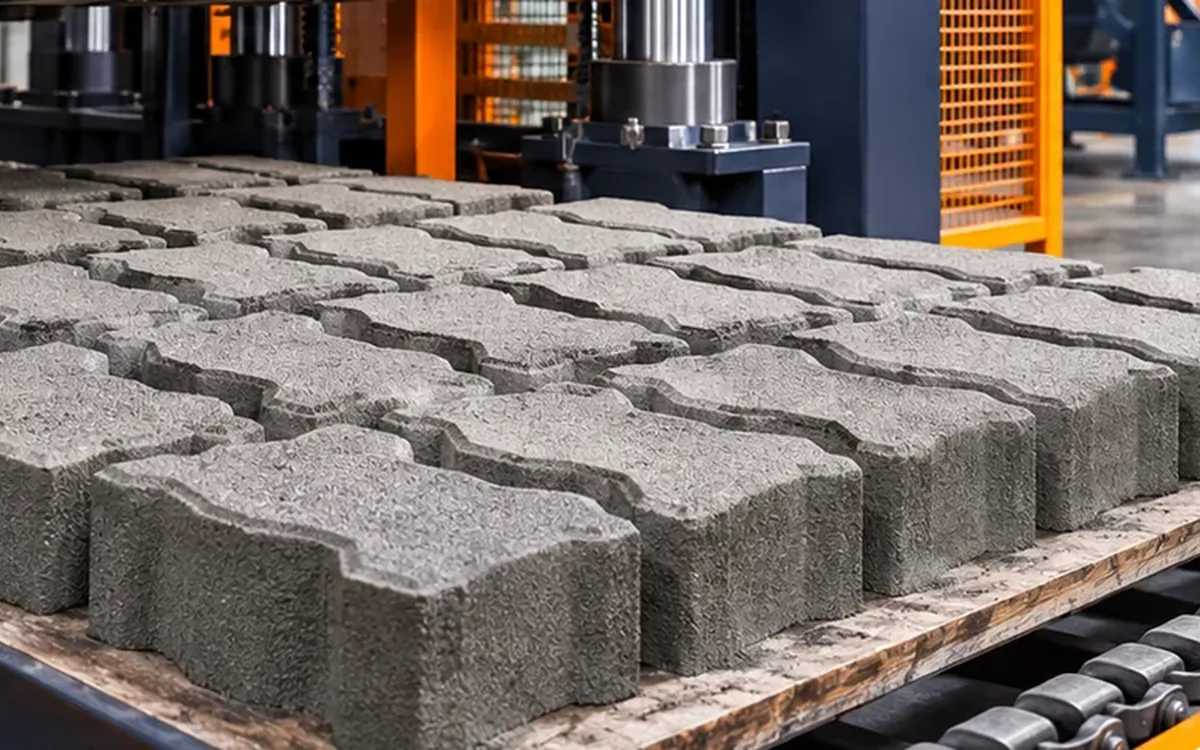
Equipment application
A mixed-product facility benefits from flexibility only if the changeover burden is understood. Equipment should be reviewed for the products actually sold rather than an unlimited theoretical range.
Paver formats and operating variables
Block and paver production can differ in feed materials, filling heights and surface expectations. Evaluate separate recipe management, mould storage and pallet inventory for the planned manufacturing programme.
Operating the connected production process
The plant flow should keep high-volume products predictable while allowing special orders without excessive downtime. This affects mixer allocation, finished-stock scheduling and cleaning routines.
Requesting a practical equipment specification
Provide an estimated product mix by share of volume, the types of moulds expected and any future face-mix requirements.
- Paver pattern and thickness range
- Surface finish and colour requirements
- Mould changeover frequency
- Expected square metres per shift
To plan flexible paver and block production press within a complete plant, see the machinery category and the connected production line options.
Managing a mixed product calendar
Flexible presses are attractive when one factory supplies structural blocks and decorative paving units. The economics depend on how often the product changes and how different the required tooling and mix recipes are. Sequence similar products together where practical, identify which settings must be verified on every changeover and maintain a clear record of first-article acceptance before normal production resumes.
Mix preparation for dissimilar products
A mix that produces robust hollow blocks is not necessarily ideal for thin or textured pavers. Water demand, aggregate grading, colour requirements and filling behaviour may differ. If the line uses a shared mixer, define cleaning and changeover rules and check whether batch scheduling creates avoidable waiting time at the forming station.
Comparison framework for buyers
Compare each proposed configuration using the same block, paver and kerbstone drawings. Record cavities per mould, attainable product height, pallet requirements, realistic changeover time and downstream handling needs. The strongest option may be the one that produces fewer theoretical units per hour but handles the planned product mix with less interruption and lower handling complexity.
Choosing flexibility over a single maximum output
A flexible paver press is generally evaluated by how well it handles several product types within a realistic schedule. Prepare an assortment showing the dimensions, thickness, expected monthly volume and packaging format of each product. Some shapes may share tooling practices while others require substantial changes to mould, tamper, filling or transfer settings. Record how frequently the plant changes from a high-volume product to a smaller specialty order. A machine that looks slower in one uninterrupted test may be commercially more useful if it can change products predictably and without excessive losses. The evaluation should therefore include both running efficiency and time lost between saleable batches.
Changeover planning as a production discipline
Tool change is not a single number. It involves stopping safely, removing residual mix, lifting the tool, aligning the replacement, loading its recipe and checking the first accepted pieces. Identify which actions require specialist staff or lifting equipment and which the regular shift team can perform. The production calendar should leave space for inspection after a change rather than assuming every cycle immediately produces conforming units. Store unused moulds where they remain protected from collision and contamination. If different paver heights require transfer adjustments, include those steps in the written procedure. Good changeover planning improves predictability without assuming that every product is interchangeable.
Managing mixes for architectural product variation
Pavers for industrial hardstanding, public paths and decorative landscapes can require different aggregate grading and surface treatment. A flexible machine cannot compensate for an unsuitable or inconsistent concrete mix. Document which products need a face layer, pigment or a different grading, and determine how the mixer will change between these batches. Cleaning and residual material may affect colour on the first pallets after a switch. Arrange raw-material storage to reduce inadvertent mixing and keep production records by product family. Acceptance testing should include the transition between mixes, not only stable operation after a long warm-up period. This is particularly important where the business offers several colours in small batches.
Mould accuracy and repeatable dimensions
A broad product catalogue increases the number of dimensional and alignment checks required. Each mould should carry an identification record with drawing revision, cavity layout, permitted product height and service history. During production, inspect units from different cavity positions and pay attention to corners or interlocking features that may wear unevenly. Some product geometries transfer or stack more readily than others, so downstream handling should be included when a new design is approved. Keep a small set of representative accepted units for comparison after tool maintenance. The goal is a controlled product-change process rather than claiming that one press can automatically make any paver shape without modification.
Plant organisation for multiple SKUs
A mixed production schedule needs more than flexible forming. Provide clearly separated storage for moulds, raw materials, green pallets and finished orders. Mark products by batch and intended dispatch destination to avoid mixing similar-looking colours or sizes. If curing and cubing operate at different speeds, use the schedule to identify when buffer stock accumulates. The selected pallet fleet should accommodate the planned product dimensions without excessive special variants. Logistics and quality staff need access to production information so the next order does not interrupt curing or shipping of an earlier one. Often the quality of the supporting workflow determines whether product variety is profitable.
Buying evidence and commercial comparison
Ask suppliers to demonstrate a realistic sequence of two or three different products, including the cleaning and adjustment steps between them. Record accepted units, time spent on tooling work, operator involvement and the status of downstream equipment during the transition. The offer should list supported mould interfaces and distinguish included tooling from optional tools. Include the required batching and face-mix arrangements in the comparison. For a useful project estimate, provide the product catalogue, shift schedule, planned labour count and country-specific utility details. This makes flexibility measurable in terms of saleable output and changeover performance, rather than an unsupported marketing adjective.
System integration: Paver flexibility means more than being able to install another mould. Different surface finishes, colours and thicknesses influence mix handling, feeding setup and product sorting. The integrated block and paver plant highlights the additional material and packaging decisions that accompany varied product orders. When planning equipment, share the expected split between standard pavers and special formats, including surface requirements and batch lengths. Those details help identify whether tooling changeover or face-mix preparation will be the main constraint.