
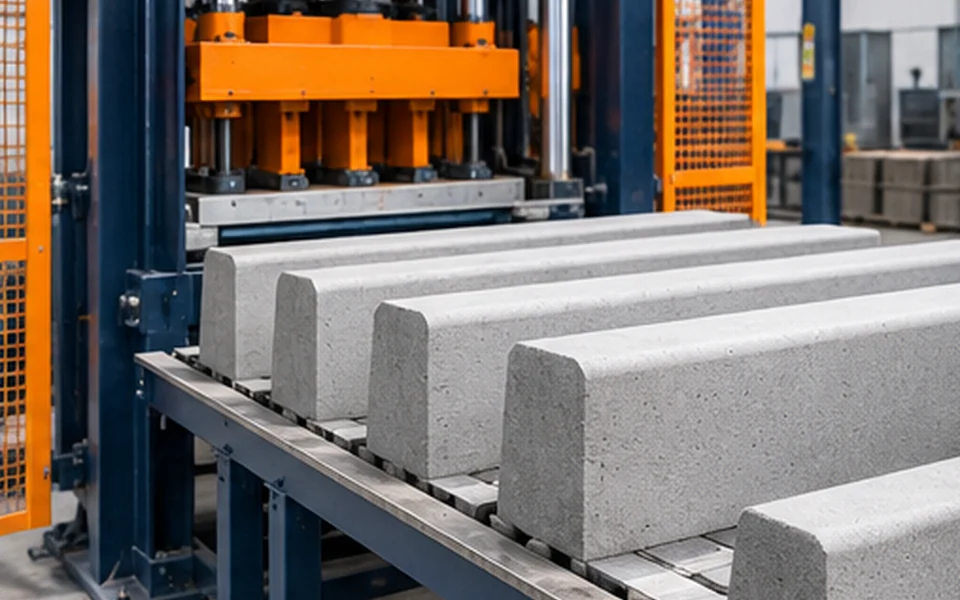
Equipment application
Heavier concrete products place additional loads on pallets, handling systems and product-lifting accessories. This equipment concept addresses projects where kerbstones form a significant share of production.
Kerbstone geometry and load handling
Mould strength, tamper geometry and feed distribution need review for thick and irregular cross sections. The ability to form a unit does not by itself demonstrate that the whole line can transfer and stack it.
Operating the connected production process
Verify pallet stiffness, safe transfer load, curing clearance and the cubing arrangement. These choices affect the overall plant footprint and dispatch workflow.
Requesting a practical equipment specification
Provide kerb drawings, weight estimates, planned output and whether drainage products or edging stones are included.
- Kerb cross-section and mass
- Mould/tamper compatibility
- Loaded pallet stability
- Safe curing and lifting plan
To plan kerbstone and heavy paver press within a complete plant, see the machinery category and the connected production line options.
Large format products require a complete handling plan
Kerbstones and heavy paving units impose a different combination of mould height, mass and handling load from standard masonry blocks. Examine how the product is supported during ejection and transport, whether the pallet remains adequately stiff and how the green unit is protected on its way to curing. Product dimensions should be checked against actual gate and conveyor clearances along the entire line.
Compaction and mould life
Deep moulds and larger masses can increase the importance of filling uniformity and the contact surfaces between tamper, material and mould. The correct approach must be established with trials using representative concrete rather than assumed from a light paving block. Consider abrasion, wear-part access and the safe handling of heavy mould assemblies as part of the purchasing specification.
Handling after curing
Finished kerbstones can require a different lifting clamp or cubing pattern than flat pavers. Agree on bundle dimensions, protection of visible faces and the transport method. If a site expects to produce channel units or edge profiles, the packaging plan should account for profiles that do not stack as easily as rectangular blocks.
Assessing mass, geometry and product stability
Kerbstones, edging units and large pavers can be comparatively heavy and tall relative to standard paving blocks. Product length, cross-section, corner radii and any drainage or alignment features determine the mould envelope and handling approach. Submit technical drawings for the largest and most awkward units, including their expected mass once cured. A heavy product can impose different pallet and conveyor loads even when the press cycle resembles that of a smaller paver. Avoid comparing machinery by the number of pieces formed without considering the size of each piece. The full product range should be evaluated for filling quality, mould release, green stability and the load imposed on downstream equipment.
Supporting pallets and transfer paths
Heavy fresh units demand a pallet and conveyor arrangement that resists deflection. Check pallet stiffness and support points under the actual cavity distribution rather than the nominal total load alone. A long kerb with limited support can develop damage that is not immediately obvious at the press. Transfer mechanisms should avoid abrupt changes of speed and provide safe clearances at guide rails and curing rack entrances. Verify the entry height, loading device and rack capacity for the tallest product. Plan suitable lift and handling methods for pallets that cannot be safely manipulated by hand. The investment scope should include these interfaces, not only the machine's forming force or footprint.
Compaction across long and irregular sections
Uniform density can be more difficult to achieve over elongated or stepped kerbstone shapes. Feeder design, vibration settings and the location of thicker sections may require testing with the proposed aggregate grading. Inspect edges and transitions where the section changes because these areas may expose filling problems before broad flat surfaces do. Record variation in height and surface texture along the full product length. Additional vibration is not necessarily the correct response to every visible defect; product mix, mould condition and feeder travel should also be considered. Use repeated samples from several cavities when assessing consistency and acceptability for the intended application.
Tool wear and frequent mould changes
A plant that makes several kerb profiles needs lifting and storage capacity for relatively large mould assemblies. Ask about replaceable wear parts and the maintenance methods used around profiles with complex shoulders or recesses. Tool cleaning after a dense concrete run can take longer than with small, simple pavers, especially where concrete accumulates around narrow cavities. Record which components must be re-aligned after removal and how the operator checks that the tool is correctly seated. A written tool-change sequence reduces the risk of damage to guide surfaces. Service access should allow work without obstructing adjacent material feeders or forklift traffic.
Curing, stockyard access and dispatch
Kerbstones occupy substantial storage volume and may need special stacking orientation to protect edges. Estimate curing positions and finished-yard space using the proposed product assortment rather than a single standard unit. Once cured, the product must be lifted, cubed or bundled in a configuration that remains stable during forklift movement and loading. Different kerb shapes may need separators, support points or straps suited to their geometry. Check whether the truck route crosses the raw-material delivery area and whether loaded pallets can be inspected safely. These practical considerations influence the factory layout and capital cost as much as press selection.
Demonstration plan and quotation information
A meaningful equipment trial should include the largest proposed kerbstone and a smaller paver if both will be manufactured. Record whether formed units remain dimensionally stable during transfer and how many products require manual correction or rejection. Verify the full mould and pallet compatibility before accepting cycle claims. Provide drawings, daily demand by shape, planned cure method, available building space, utility conditions and intended packaging system with the inquiry. The quotation should explicitly list included moulds and any handling or finishing equipment. This establishes whether the proposed system can produce, cure and dispatch the real products rather than only form them at the press.
System integration: Heavy kerbstone profiles may be formed on equipment that can also produce paving products, but the factory must handle the mass and geometry of the largest planned unit. Review pallet loading, mould lifting, curing transfer and dry-side packaging before fixing a proposed press. The integrated production concept shows where product range changes can affect the process. In a technical enquiry, include the heaviest profile drawing, required edge geometry and the available lifting and dispatch arrangements; theoretical machine speed alone will not answer these questions.