
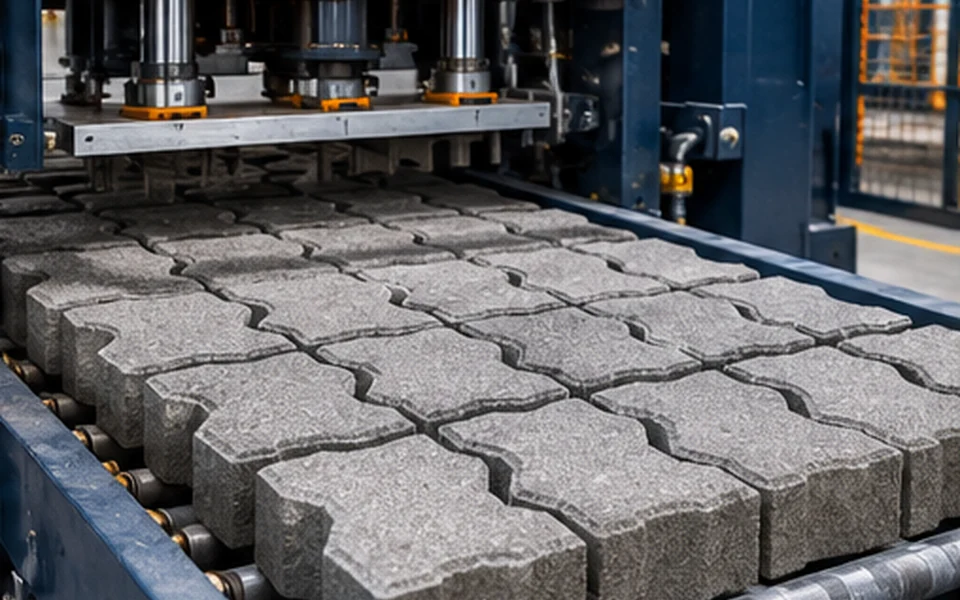
Line concept
A paver production line is organised around the geometry, surface finish and daily square metres of finished paving products required by the market.
Aggregate dosing and mixing feed the forming press, which runs the selected mould and pallet combination. Fresh pavers must travel to curing without losing their edge or surface finish. Cured products move to stacking and appropriate transport packaging.
Process flow and capacity balance
Face-mix colour systems and surface treatment may be needed for particular decorative products. Including them early allows adequate space, material separation and process control.
Scope for project planning
Output calculations should account for paver thickness, pieces per cycle, curing capacity and pallet return times rather than using only press cycles per hour.
Explore machinery options and engineering support topics before requesting a proposal.
Product family and visible finish
Paver manufacturing can include multiple thicknesses, shapes, colours and face-layer textures. These choices affect the press mould, mix recipes, feeder system and changeover procedure. Build the plant around a representative product programme rather than promising identical throughput for every decorative paver design.
Colour consistency and layered products
If two-layer pavers or coloured surfaces are planned, separate face-mix preparation and controlled feeding may be required. Compare the added cleaning time, pigment handling and colour batch traceability with the commercial value of the product range. Surface texture, edge condition and appearance after curing should be evaluated against customer samples.
Packing for transport and installation
Consider whether pavers will be supplied as standard stacks, mixed-size sets or layers suited to mechanical installation. Define cube pattern, pallet footprint, wrapping and edge protection early. This decision influences the cubing station and the efficiency of dispatch, not just the final warehouse area.
Related machinery: Examine the Automatic Interlocking Paver Machine as one possible equipment element, then request a project review with factory dimensions and target product drawings.
', `image_path`='assets/images/cbm-paver-mould-compaction.webp', `image_alt`='Concept visual illustrating Automatic Paver Block Production LineSet the commercial paving programme first
An automatic paving facility should be planned around the square metres and patterns the market will actually purchase. Small interlocking stones, larger slabs and architectural paving have different mould occupancy, thickness and handling requirements. Define the initial product assortment with drawings and required finishes, then estimate how frequently moulds and colours will change. A line suited to continuous production of one grey paver may be less efficient for many short decorative batches. The project brief should include saleable area per shift and the normal working calendar rather than only stones per pallet. Treat marketing assumptions about growth separately from a documented first-year production plan. This avoids overspecifying forming equipment while underfunding colour preparation, curing or packing that the chosen products will require.
The material route for premium pavers can be more complex than the base-mix route for ordinary masonry units. If a coloured surface layer is planned, the factory may need separate ingredient storage, pigment dosing, mixing and face-mix feeding. Establish how materials are kept apart during production and how lines are cleaned between shades. Record the effect of sand moisture and aggregate variation on appearance, because a fixed pigment dosage does not guarantee identical visual results. The mixer-to-press transfer should not allow material to harden or segregate before distribution. Where two concrete feeds meet in the mould, the operating sequence must create the required bond and repeatable surface thickness. Acceptance samples should be made under realistic batch-change conditions, not only during a long uninterrupted run of one colour.
Forming settings for different laying patterns
Interlocking paving needs dimensionally compatible units that fit the intended installation pattern. Mould edges, tamper details and feeder distribution affect whether corners stay sound and surfaces remain even. A plant producing several paving patterns needs a planned mould storage and changeover area, including safe lifting provisions. Validate products from different mould cavities and repeat the dimensional checks after changeover. Larger or irregularly shaped slabs can limit the number of units on each pallet and alter the acceleration tolerated during transfer. The production estimate should therefore be made separately for each important product family. A process trial should include the heaviest unit and one demanding edge profile, because simple rectangular stones seldom reveal every tooling and handling weakness.
The wet side must move newly formed paving without dragging or striking its visible face. Pallets need correct support through transfer, elevator and rack positioning, and the controls should prevent movement into occupied curing positions. Plan curing inventory from the actual forming schedule and the mix-specific period needed before safe dry handling. Pay attention to moisture and temperature conditions because inconsistent curing may affect both strength development and surface appearance. Use batch identifiers so later inspection can connect visible differences to raw materials, forming recipes and curing position. Where decorative slabs are particularly sensitive, the proposed line should explain how it reduces abrasion during retrieval. These details may matter more to customer acceptance than a small improvement in machine cycle time.
Finish and package pavers for the installer
The dry-side line should form loads that distributors can store and installers can handle efficiently. Determine whether finishing operations such as brushing, washing or surface texturing are part of the planned factory or handled separately. A finishing station changes conveyor layout, dust or water management and the time before packaging. Cubing equipment must grip the chosen profile without chipping the edge or scuffing a coloured face. Finished packs may need protective separators or a defined wrapping method, especially when appearance is a selling feature. Ask to see the complete product route into a dispatch-ready load. A site layout that ends at the press fails to account for these practical tasks that determine whether produced square metres become saleable stock.
Calculate saleable area using mould cavity count, the footprint of each product, realistic pallet cycles, normal lost time and an agreed rejection allowance. Keep separate estimates for standard grey pavers, face-mix units and larger slabs. Colour changeovers and extra surface operations should appear explicitly rather than being hidden inside a headline output. Compare proposals using common shift assumptions and the same product drawings. Examine whether mixers, pallet circulation and curing storage can support the forming rate in practice. Ask for a staged acceptance test that includes appearance, dimensional measurements and packing as well as machine operation. These records make technical decisions more robust than optimistic average cycle claims that cannot be traced to a particular unit or recipe.
Create a complete paving-project brief
Send suppliers the planned paving catalogue, normal order quantities, product drawings, colours, required visible finish, production shifts and factory dimensions. Confirm whether the scope includes moulds, base and face-mix equipment, curing, optional finishing and cubing. Identify energy supply, water availability, dust or wash-water constraints and the intended method of shipping completed packs. Request a process diagram and a written equipment boundary from each bidder. Compare the automatic interlocking paver machine with the paver mould set to understand how tooling affects line performance. A solid proposal will describe an end-to-end route from ingredients to a finished paving pack, not merely the press.