
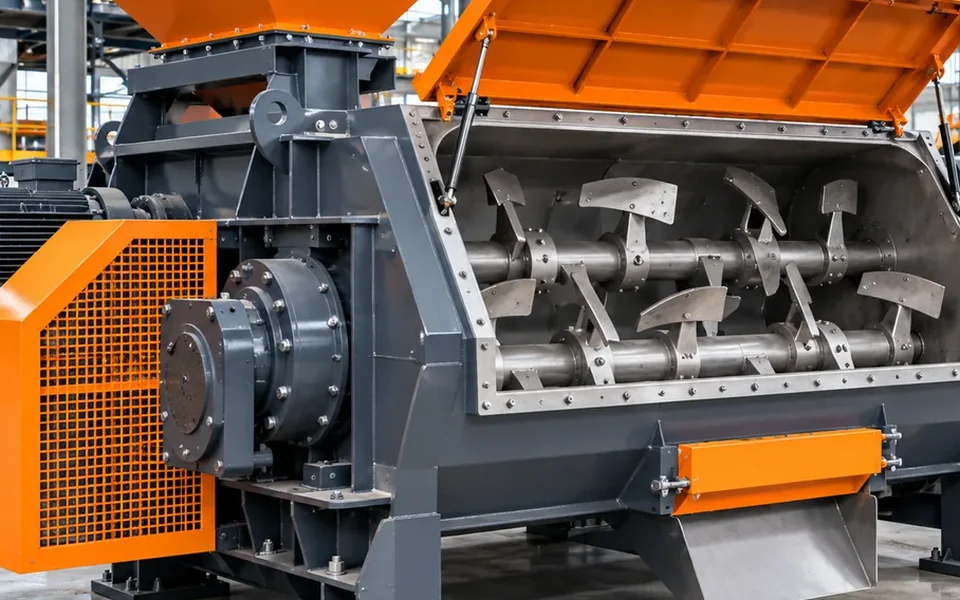
A twin-shaft concrete mixer can be considered where a block factory needs repeatable preparation of stiff concrete across frequent production batches. The equipment does not determine block quality by itself: aggregates, dosing accuracy, moisture control and the feeding arrangement must work together. This guide focuses on the operational questions that should be settled before a twin-shaft mixer is specified for a block or paving-stone plant.
Mixing action and the low-slump production requirement
Concrete for vibro-pressed products is often designed to retain its shape immediately after the mould releases it. That relatively stiff behaviour puts particular pressure on material distribution inside the mixer. The buyer should examine how the shafts, paddles and discharge area move aggregates and cement paste through the working volume rather than assuming that every mixer geometry performs identically. The most useful evidence comes from trial batches produced with the proposed aggregate grading and moisture conditions. Compare samples taken at different discharge points, noting visible colour, fines distribution and the tendency for material to form localised pockets. A uniform appearance does not prove strength, but inconsistent discharge is an early reason to investigate the recipe and mixing sequence.
The specified mixer should be assessed alongside the moulding machine and the intended products. Hollow masonry units may expose poor distribution through inconsistent web formation, while thin paving units can reveal changes in surface compaction and colour. Discuss whether the concrete will be used for a base layer, a face layer or both, because those recipes may require different handling and contamination controls. The correct mixing method is the one that supplies an acceptable feed to the block press repeatedly, not the one with the largest nominal vessel or the shortest advertised batch interval. Ask for batch trials that represent normal operating variation, including the transition between recipes.
Batch size, loading order and discharge coordination
A mixer must be sized around the usable production batch, which is not necessarily the same as its geometric vessel volume. Determine how much concrete a moulding cycle consumes, how the feed hopper buffers deliveries and whether the mixer can reliably replenish that buffer without long idle periods. Batch frequency must consider loading, dry mixing, wet mixing, discharge and any required cleaning. A mixer able to make a very large batch may be an awkward choice for factories that regularly change colour or product type. It can leave material waiting inside equipment while the next press changeover is prepared. Use an operational duty chart with actual block and paver products to describe what the mixer must deliver through the shift.
Discuss the order in which coarse and fine aggregates, cement, pigments, admixtures and water enter the mixer. Changes in sequence can affect the way fines coat aggregate particles and the way water is distributed in stiff mixes. Check whether the batch is fully discharged before the next mixture enters and how residual concrete is detected. The feed conveyor or skip must also tolerate variations in discharge rate without creating segregation. Where a base-mix and face-mix system are proposed, identify exactly which mixer supplies each stream and how the control system prevents a recipe from being delivered to the wrong hopper. Integrated batching and forming should be evaluated as one timing problem.
Liners, paddles and inspection access
The parts that contact abrasive aggregates are central to the lifetime operating cost. Ask for drawings or service information describing replaceable floor liners, side protection, paddle assemblies, shaft-end seals and access to the discharge gates. A purchase decision should establish which wear items are expected to require regular inspection and which require a planned shutdown for replacement. Even where two mixers have comparable mixing capability, service access can make a large difference to how consistently the plant operates. Operators must be able to observe wear without defeating guarding or entering an unsafe moving area. The safe isolation procedure should be documented for cleaning and inspection, not improvised after commissioning.
Shaft seals and bearings deserve specific attention because wash water, fines and aggressive cleaning practices can accelerate deterioration. Request the lubrication method, alarm and inspection provisions, and a parts diagram that maintenance staff can use without relying on informal descriptions. Ask how worn paddles influence mixing quality before a failure becomes obvious, and whether the controller can record operation time or service alerts. If the factory is expected to make pigmented pavers, discuss cleaning between colours and places where residue can remain trapped. A design that is easy to wash down but difficult to inspect may still generate avoidable downtime, so maintenance planning should be reviewed with the daily production schedule.
Electrical, structural and environmental integration
A mixer is more than a machine bolted to a steel platform. The plant designer must confirm how loading hoppers, discharge equipment, support structures, service platforms and surrounding walkways are arranged. Heavy modules and dynamic operating loads require project-specific engineering and a foundation or steelwork assessment by competent professionals. Ask for installation drawings, service clearances and lifting provisions before the site layout is finalised. Electrical integration must cover the actual supply, control-voltage requirements, starting characteristics and safety interlocks. The presence of a motor specification is not sufficient proof that the connected plant can support simultaneous mixer and vibro-press operation without unwanted interruptions.
Dust control, wash-water management and drainage should also be designed before the machine arrives. Cement and dry aggregates can create emissions during loading, while cleaning produces slurry that cannot simply be allowed to build up beneath equipment. Identify where water is recovered or discharged and what local environmental requirements apply. A useful factory plan separates personnel movement from feed conveyors and places routine service points where they remain accessible during operation. Discuss the mixer and the batching category together so that enclosure design, aggregate supply and safe inspection are treated as related responsibilities rather than isolated accessories.
Control philosophy, commissioning and acceptance tests
An appropriate acceptance test should connect batch data to product quality rather than checking only whether the motor turns and the gate opens. Agree on representative mixes, sequence timing, discharge observations, weighing records, sensor alarms and the expected response to a blocked conveyor or a missing ingredient. If the proposed controller permits recipe storage, confirm how changes are authorised, recorded and restored after a control failure. This is especially important when a plant produces different surface colours or alternates between blocks and paving stones. Operators should know which parameters they can change during routine production and which adjustments require supervisor approval or a new validated recipe.
Ask for electrical diagrams, hydraulic or pneumatic information where applicable, maintenance instructions, an equipment layout and a usable parts list. During commissioning, observe a complete production sequence from aggregate dosing through block forming and green-product transfer, including a deliberate pause and restart. The test should show that a mixer cannot discharge into an unavailable receiver and that faults are clearly communicated to operators. Record any deviations and the responsibilities for closing them before acceptance. The guide to concrete mixing helps frame the questions without confusing a mixer rating with saleable factory output.
What to include in the project enquiry
A useful enquiry states the concrete products, approximate daily mix demand, aggregate grading, cement delivery method, site conditions and whether coloured face mixes will be manufactured. Include the number of shifts, expected recipe changes and any existing batching equipment that must be retained. If the desired plant includes future expansion, show how a second mixer or alternative discharge route might be accommodated rather than assuming more motor power will solve every bottleneck. Details about available electrical supply, water management and building height are important even for a mixer-only project. Sending this information early allows the supply scope to distinguish mandatory equipment from options.
Request a proposal that lists the mixer, supports, charging and discharge interfaces, control integration, guards, wear items and documentation as separate elements. A clear scope should also identify transport, installation, commissioning, training and the customer’s civil and utility responsibilities. Avoid comparing offers solely by nominal batch capacity or a quoted mixing time; the effective performance depends on the actual material and the wider factory sequence. If the factory is already operating, provide examples of current batch inconsistency or stoppages rather than relying on an assumed capacity target. The objective is to specify equipment that fits the existing or proposed production system and can be serviced reliably.