
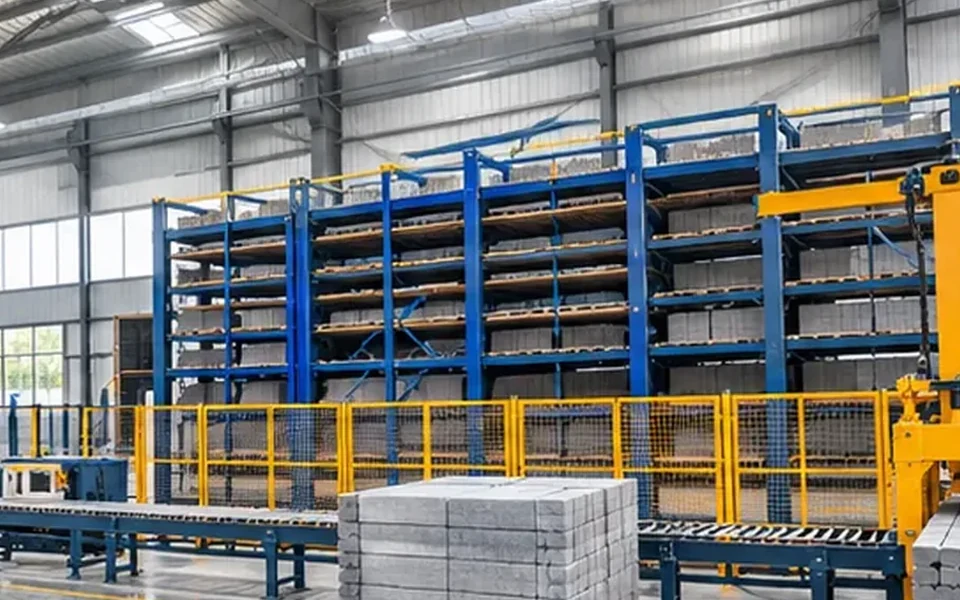
The dry side of a block plant begins after products have developed sufficient strength for handling. A lowerator and transfer conveyor system must remove pallets from curing storage, present the products to downstream processing and return the production carriers without damaging saleable units. Its design depends on pallet geometry, rack arrangement, product mix and the chosen cubing method, making it a central part of sustained factory output rather than a simple unloading accessory.
Confirm the curing exit conditions
Before selecting the unloading mechanism, define how pallets arrive at the dry-side transfer: rack type, stacking pattern, presentation height and the direction of movement. A lowerator that is compatible with a single rack format cannot automatically be assumed to work with every store or mobile handling system. Verify the permissible product load and the way a pallet is supported while the rack is unloaded. The fresh-to-cured transition also depends on the product condition. A block that is ready for one type of transfer may still be vulnerable to rough gripping, unstable stacking or surface abrasion. Operating procedures must describe the quality and handling checks needed before pallets enter the dry side.
Curing storage frequently contains different products at different stages. The controller or operating plan must make the intended release order understandable and prevent inexperienced staff from selecting the wrong rack. Product identity can affect the downstream gripping pattern, pallet separation and packing method. Ask how the lowerator receives this information and what happens when a rack is not fully populated. The curing and pallet circulation system and the automatic curing and cubing line show how unloading fits into the wider production model. The aim is not simply to empty storage rapidly; it is to release the correct product in a condition that the dry-side equipment can handle consistently.
Mechanical guidance and pallet separation
The lowerator must move pallets without allowing uncontrolled tilt, collision or scraping against adjacent products. Examine guide rails, lifting elements, support surfaces and mechanical stops in relation to the actual pallet material and expected load. Some products overhang their supporting pallet or have exposed edges that narrow the safe travel envelope. The specification should make these conditions explicit rather than describing only nominal pallet dimensions. A practical trial should cover the largest intended product, a typical standard product and any unusually delicate surface finish. Movement speed may be adjustable, but smooth handling and reliable positioning should take priority over maximum travel velocity when the cost of product damage is significant.
Separating one pallet from the rack and presenting it to a conveyor demands coordinated timing. Confirm how the machine verifies the next conveyor is clear, whether buffers are available and how a partially removed pallet can be recovered safely. Poor alignment can produce repeated small impacts that gradually damage pallet edges and product surfaces. If the system includes a lifting platform, workers should have access to inspect guide wear and drive components only under safe isolation. Ask how jammed or skewed pallets are detected and what information is shown to operators. Maintenance access must be planned into the factory layout, because an inaccessible lowerator can create long interruptions when an otherwise minor mechanical issue occurs.
Cured-product transfer and interface to cubing
Once unloaded, the pallet must reach the chosen separation, sorting, cubing or packing equipment without unnecessary handling. The transfer conveyor should be designed around the footprint and support points of the production pallet and the acceptable acceleration for the cured products. Surface-sensitive pavers may require gentler transfer behaviour than standard hollow masonry units. If the line changes between blocks and paving products, the downstream gripping and stacking arrangement may need different recipes or mechanical tooling. A good design keeps the product route clear, identifies positions for inspection and allows rejects to be removed without stopping a large section of the factory unnecessarily.
The lowerator cannot sustain full output if the cubing station frequently refuses pallets or if empty carriers cannot return to the press. Analyse the whole sequence from curing store to saleable bundle and empty-pallet recovery. A buffer may absorb short interruptions, but its capacity should be based on realistic production conditions rather than an optimistic cycle figure. Ask where the system places a pallet when the stacker is unavailable and how an operator can safely clear that accumulation. The automatic block cubing and packing station is the natural downstream interface; both devices must share clear readiness signals and a tested recovery procedure. Equipment supplied by different companies needs defined responsibility at every transfer point.
Sensor placement, guarding and fault recovery
Position detection is essential when pallets move between levels or through restricted areas. The control system should confirm the presence, alignment and readiness of each pallet before initiating a motion that could create a collision. Sensors exposed to dust, concrete fragments or vibration require appropriate mounting and maintenance access. Operators should receive useful fault information, such as the station at which a pallet has failed to reach position, instead of a generic alarm requiring trial-and-error troubleshooting. During design review, identify which movements are stopped by each interlock and what happens following a loss of electrical power. A safe state must be predictable and documented.
Guards, access doors and emergency devices must be planned for the actual plant layout. The lowerator may sit beside curing racks, conveyors and forklift routes, creating several possible approach directions. These need to be covered in the risk assessment rather than assuming one front guard protects every hazard. Maintenance personnel require safe access for chain, drive and guide inspection, cleaning and adjustment. Test controlled recovery from a pallet that has stopped between positions and from an unavailable receiving conveyor. The goal is to protect people and equipment while making fault handling clear enough that operators do not feel compelled to bypass safeguards to restore production.
Production planning and traceable dry-side flow
A dry-side handling system should support the plant’s actual order book. If the factory makes several product colours or sizes, identify how those products are separated, queued and directed to the correct cubing or packing route. A simple plant may use operator confirmation while a more automated arrangement can exchange product identifiers across controllers. Either way, the release of cured products must be coordinated with storage availability and dispatch priorities. Unexpected accumulation of pallets in a dry-side aisle can disrupt forklift routes and create safety concerns. The layout should define where saleable products, rejects, empty pallets and packaging materials belong without competing for the same space.
Useful production records include unloading stoppages, rejected pallets, product changes and times when the cubing station cannot accept another load. These data allow the factory to distinguish a true machine fault from a scheduling or storage problem. Ask whether operating events can be viewed and exported in a form relevant to supervisors and maintenance teams. The guide to handling and curing emphasises why cured-product flow is part of production capacity, not simply a final convenience. A lowerator that performs well in isolation may still underperform if storage discipline or downstream pallet return is not properly planned.
Specification, commissioning and documentation
Provide rack and pallet drawings, product weight ranges, curing discharge arrangement, available floor and ceiling clearance, planned conveyor route and the downstream machine interfaces. Clarify the intended automation level, communication signals and whether multiple product groups require different handling recipes. The quotation should describe the lowerator, transfers, guards, sensors, drives, controls and installation responsibilities in separate terms. Identify which measurements must be confirmed on site and who supplies support structures or civil works. This avoids commissioning disputes caused by a machine arriving without the necessary compatible receiving equipment. Service clearances and lifting access should be reviewed before site construction is finalised.
Acceptance should use representative cured pallets, including a product that requires gentle handling and another that represents the normal high-throughput case. Observe loading, unloading, product transfer, empty-pallet routing, planned stops and selected safe fault simulations. Record whether units are damaged and whether the controller can be restarted without losing track of material already in the system. Request drawings, spare-part references, maintenance instructions, risk documentation, control backups and operator training. The final evaluation should compare saleable product flow and safe recoverability with the project brief. A lowerator is valuable when it protects finished concrete while keeping the entire plant organised and serviceable.