
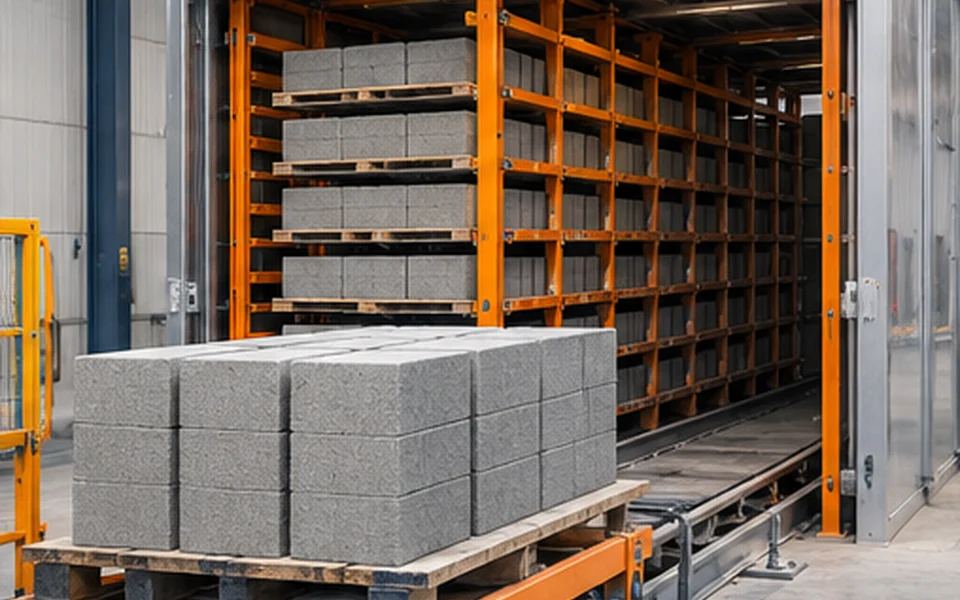
How curing space, pallet circulation and cubing influence the whole production line.
After forming, blocks and pavers require time and suitable conditions to develop strength. Fresh units can be damaged by vibration, impact or poor handling before that strength has developed.
Plan wet-side transfer paths to minimise jolts and unpredictable stops.
Curing capacity should be based on pallets produced over a period and the time each pallet occupies storage. Temperature and humidity influence strength development, and the correct regime depends on the mix and product.
Rack layout must allow safe loading, transfer and inspection.
Once sufficiently cured, products can be removed from production pallets and arranged for packing. The empty pallets return to the press after inspection or cleaning.
A poorly coordinated pallet loop can force production to stop even when the press itself is ready.
Finished cube size, forklift movement and vehicle loading determine how the plant uses its floor and yard space. Early planning avoids a bottleneck at the very end of the line.
When evaluating planning curing and handling in block factories, record the operating assumptions most relevant to the proposed product mix and factory conditions. Ask for a written scope of equipment, utilities and product quality verification.
For related equipment see concrete block machinery and plant configurations.
A freshly demoulded block may hold its shape without having enough strength for rough transport. Smooth transfer, appropriate pallet stiffness and secure rack positioning matter before curing even begins. Map the actual mechanical route and remove abrupt changes of direction or unsupported spans that could cause hidden cracks or distorted units.
Estimate how many loaded pallets arrive during a normal shift and how long each occupies a rack or curing location. From that figure, determine storage positions and the number of return pallets needed. The objective is not simply to fit as many racks as possible but to allow safe access and a predictable product movement sequence.
Curing temperature, moisture and dwell time affect the development of concrete properties and should be established for the intended mix and local conditions. Collect samples at an agreed frequency and trace their production batch. Final packing should start only after products are suitable for the planned handling and transport method.
Plan around green-product vulnerability
Freshly vibro-pressed concrete units are still developing the strength needed for normal handling. A unit that looks stable on the press pallet can suffer chipped edges, distortion or surface marks if the wet-side transfer introduces impacts or uneven support. Draw the route from the forming station into curing as a gentle, controlled movement with defined pallet alignment. Consider product height, weight, mould geometry and any decorative face that should not contact guide components. The wet-side conveyor and lifting arrangement must be compatible with the actual pallet and its load, not just the press cycle time. Inspect likely pinch points and the consequence of a pallet that enters a transfer station out of position. Good handling design protects products during the stage when the factory has already invested in materials and forming time but has not yet made saleable stock.
Calculate curing storage from time and flow
Curing inventory depends on how many pallets enter the system during a realistic production period and how long the product remains before it can leave the curing area safely. It is therefore a time-and-space calculation, not simply a rack count. Account for the intended product range because taller blocks, thin pavers and heavier units can require different storage clearances and handling restrictions. Identify the storage that remains occupied across shift boundaries and how the line behaves when the curing store is close to full. A plan that relies on every pallet becoming available at an exact predicted moment can create unnecessary press stoppages. Consider seasonal temperature and humidity conditions when defining the curing strategy, while keeping any precise recipe or performance claim subject to validation. Storage design should preserve access for inspection, maintenance and safe product retrieval.
Define curing conditions and product acceptance
Curing is part of the manufacturing quality process, not merely waiting before packing. Temperature, moisture control, duration and environmental exposure influence product development, and the chosen approach must suit the mix and the factory's circumstances. Ask which parameters the process will monitor and how operators are notified when conditions leave the intended range. Avoid assuming that every product can follow the same schedule without evidence from testing and experience. Where racks or chambers are used, evaluate airflow and how products are arranged to avoid inconsistent exposure. Establish sampling and finished-product checks according to the relevant destination-market requirements. A curing plan should make it possible to connect quality results with the batch and storage history rather than treating defects as isolated events discovered during dispatch.
Balance the dry side with the press and curing store
Once products have developed suitable handling strength, the line still needs to unload pallets, form cubes, protect surfaces and organise dispatch. A slow cubing station can block the empty-pallet return route, eventually affecting the press even if curing storage is sufficient. Consider whether blocks are stacked by product type, customer order or pallet load and how frequently the factory changes the stacking arrangement. Fragile edges and decorative paving surfaces may require different gripping and transfer decisions from dense standard masonry. Packaging materials and forklift access should be planned around the physical bundle that leaves the line. A site that ignores the dry side can end up storing saleable product in inconvenient positions while the forming station waits for empty pallets. The curing and cubing line describes this downstream sequence in more detail.
Review handling failures during commissioning
A realistic trial should use the actual pallet material and product geometry and include controlled starts, stops and selected interruption scenarios. Check sensor positioning, pallet transfer alignment and whether operators can remove damaged products without unsafe entry into moving equipment. Record which buffers become full and how the control system prevents the press from releasing another pallet when the next stage cannot accept it. Test the empty-pallet return as carefully as the green-product route. Provide instructions for cleaning, inspection and safe isolation of conveyors, elevators and grippers. Linking curing records to realistic output planning gives the factory a more accurate basis for production schedules. The best handling design is one that preserves product quality while making interruptions visible and manageable.