
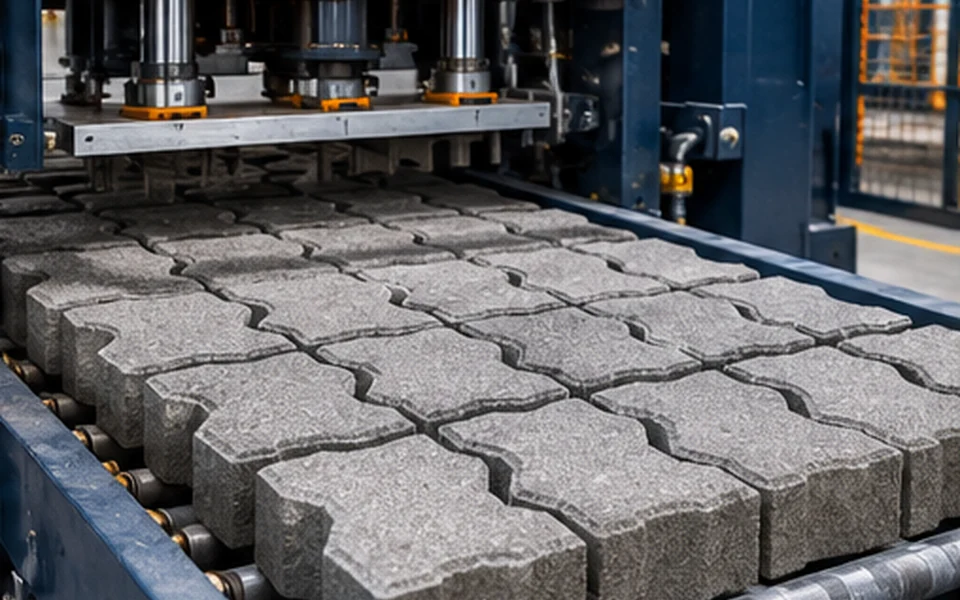
A practical method for calculating pieces per shift without confusing theoretical cycles with saleable product.
The starting point is the number of units formed on one pallet. Multiply it by achievable cycles per hour and scheduled running hours to estimate gross output. Then adjust for mould changes, maintenance, material interruptions and product rejection.
This method makes it clear why two plants with the same press can achieve different results.
Hollow blocks and pavers may require different filling and compaction settings. A nominal 20 × 40 × 20 cm block figure cannot be transferred directly to a paver measured in square metres.
For paving, calculate units per pallet and convert the produced area using the dimensions of each unit.
The press cannot operate continuously if the mixer cannot supply material or curing racks are full. Check batching, pallet supply, green transfer and packing capacities against the same production target.
A simple bottleneck chart is often more useful than an isolated maximum machine figure.
A credible project calculation lists product dimensions, cycle time, net shift hours, availability and expected rejects. These figures should be reviewed during trials with the actual aggregates and mix.
When evaluating how to estimate block machine output, record the operating assumptions most relevant to the proposed product mix and factory conditions. Ask for a written scope of equipment, utilities and product quality verification.
For related equipment see concrete block machinery and plant configurations.
Start with cavities per mould and an assumed cycle interval to obtain theoretical units per hour. Apply the planned operating hours and then account separately for downtime, product changeovers and rejects. Do not combine all losses into an unexplained efficiency percentage. A simple sensitivity table showing faster and slower plausible cycles is usually more useful than a single exact-looking output promise.
Hollow blocks, pavers and heavy kerbstones can require different filling, compaction, transfer and handling assumptions. A multi-product plant should be assessed as a schedule of production runs rather than multiplying one favourite catalogue number across all products. Include time for mould changes, cleaning, quality inspection and packaging changes where they matter.
Even a sound forming estimate can fail if the mixer cannot supply enough material, curing storage fills up or the cubing station cannot clear finished units. Verify the required pallets per hour at each transfer point and identify buffers. Report a capacity range and the evidence needed to refine it after trial production rather than stating an unsupported daily guarantee.
State the production assumptions explicitly
An output estimate is a model of operating conditions, not a promise that a machine will deliver a fixed quantity in every factory. Begin with the exact product drawing and the number of acceptable units intended per pallet. Define the press cycle time under that product and mix, then record scheduled hours and the expected time allocated to planned stops and normal operator activities. Do not combine one supplier's fastest demonstration cycle with another supplier's cavity count or a full uninterrupted eight-hour shift. Ensure that the calculation distinguishes a hypothetical gross forming quantity from good product after inspection and curing. For a factory selling several product formats, create a separate estimate for each major format. A weighted product schedule can then describe a typical working week more accurately than a single headline figure.
Work through a hypothetical capacity calculation
Suppose a proposed mould arrangement makes twelve pieces per pallet and a validated operating scenario sustains three pallets per minute while the forming station is actually running. That suggests thirty-six pieces per active minute before downstream losses or interruptions. If the factory has a six-hour effective forming window, the arithmetic yields 12,960 gross pieces for that illustrative scenario. It is not a machine rating and should never be used as a universal expectation. A change in product geometry, mixture consistency or downstream transfer can change the achievable cycle and therefore the result. Add realistic allowances for mould changes, cleaning, waiting for concrete and maintenance. Then account for rejected pieces and the output that successfully completes curing and packing. The useful number for a business plan is saleable production, not the largest gross figure that can be produced by multiplying optimistic inputs.
Find the slowest connected stage
A press is one element of a serial production process. A mixer that cannot prepare concrete in time will create gaps between cycles, while a curing rack that reaches capacity will halt green-product transfer. A cubing station with insufficient output can leave dry pallets in storage and eventually delay empty-pallet return. Compare the estimated rate of each stage using the same product mass, pallet size and operating schedule. Check buffer capacities and whether material can wait without harming the product or production process. A balanced line does not require every component to have identical cycle times, but it does require enough storage and control to handle normal variation. The plant layout and controls must make the bottleneck visible so operators can resolve the correct problem instead of speeding up the press without improving dispatch.
Use a range rather than a single optimistic number
Early estimates should show a conservative case, a realistic planning case and a better-running scenario if enough evidence exists to justify them. Explain what changes between the cases: availability, actual cycle time, reject rate, product changeover frequency and downstream utilisation are more informative than an unexplained percentage reduction. Record how many operating shifts are needed to reach the sales target and whether demand supports year-round use of that schedule. New products often have a learning period while operators tune moisture, vibration, feeding and mould settings. Compare total factory investment against the conservative and realistic cases, not only the upper limit. A range gives managers a clearer view of risk and highlights which assumptions should be proven during factory or site acceptance.
Verify the calculation against operating evidence
After installation, collect actual data for formed pallets, product families, rejected units, planned downtime and unplanned faults. Compare those records with the original model and investigate material shortages, slow changeovers or curing congestion separately. A practical acceptance trial should record the concrete mix, mould used, personnel involved and the stable operating interval, because conditions affect the meaning of any observed rate. Keep records for product quality, not only press strokes. For a more complete purchasing assessment, read questions before buying a production line and review the full production-line concept. An honest capacity estimate is one a buyer can reproduce from documented assumptions and improve as the factory develops.