
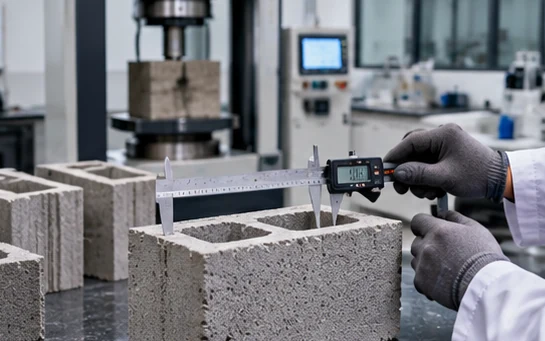
A concrete-products factory needs more than a final strength certificate to demonstrate reliable quality. Blocks, interlocking pavers and kerbstones must meet the requirements of their intended applications while being produced through changing materials, shifts and weather conditions. A practical quality-control plan connects incoming materials, process settings, sample identification, product testing and corrective actions. It should identify the correct local specification for each product family rather than applying one test regime to every shape and market.
Translate product specifications into a measurable control plan
Start by defining the unit's intended use, nominal dimensions, permitted tolerances, physical-performance requirements and presentation expectations. Structural masonry units, pedestrian paving and road-edge products may be governed by different standards or project specifications. For example, ASTM C140/C140M covers sampling and testing methods for concrete masonry units, while ASTM C936/C936M addresses solid concrete interlocking paving units; the correct edition and jurisdiction must be checked for the actual order. The plant should not assume that one certificate qualifies every product it manufactures.
Convert those requirements into a test matrix with sampling points and frequencies. Identify whether checks apply to raw materials, fresh products, cured stock or dispatched batches. Name the person authorised to accept a result or hold a lot. A written plan prevents production pressure from silently changing the acceptance rules during a busy shift.
Control incoming materials and their variation
Aggregate grading and moisture affect packing, cement-paste demand and the way a mixture fills a mould. Cementitious materials and admixtures can vary in behaviour even when their product names remain unchanged. Record supplier, delivery identification and relevant material test results. When a source changes, assess whether the established recipe and forming settings remain valid.
Keep storage areas and batching systems arranged to limit unplanned material mixing and contamination. A moisture correction made for one sand bin should not automatically be applied to another. Maintain calibration records for weighing and dosing equipment. Accurate recipe targets provide limited protection if the devices delivering the ingredients are drifting.
Measure fresh-product consistency at the press
Early checks can reveal defects before a full production batch reaches curing. Inspect mould filling, edge integrity, product height, surface appearance and the pattern of weight across positions. Retain a labelled reference sample when appearance is important, especially for architectural pavers. Changes should be recorded against recipe, mould, machine settings and material lot, so that the source of variation can be investigated.
Sampling should represent the actual production run rather than only the best-looking first pallet. Include output from different mould positions and, where appropriate, from both the start and the stable middle of a shift. A single attractive unit is not evidence of consistent production. Clear sampling instructions help avoid disputes over which pieces were tested.
Distinguish visual inspection from physical testing
Visual checks are valuable for detecting cracks, chipped edges, colour differences and surface defects, but they cannot substitute for strength, absorption or durability tests where those are specified. Laboratory procedures require suitable equipment, specimen conditioning and a documented method. Do not infer compressive strength from a product's apparent density or from a brief demonstration of how it sounds when struck. Qualified laboratories and the applicable standards provide a more reliable basis for acceptance.
Test records should include sample identity, age or conditioning history, measurement method, results and the acceptance criterion. Where periodic third-party testing is required by a customer or authority, plan the schedule and budget before production begins. A good traceability system allows a questionable shipment to be located without placing the whole warehouse on hold.
Use process trends, not only pass-or-fail results
A process can remain formally within tolerance while drifting toward a limit. Plot key measurements by date, shift, mould and recipe so gradual changes become visible. Look for patterns: rising height variation after a mould change, increasing rejects when sand moisture changes, or a specific cavity that repeatedly produces damaged corners. Investigate those trends before they become costly nonconforming stock.
Control charts and other statistical tools can help when data quality and sampling frequency are sufficient. They do not replace engineering judgement or a properly established specification. Define how a trend triggers maintenance, recipe review or extra sampling. Recording data without a response plan can create an impressive dashboard with little operational value.
Manage nonconforming product without hiding the cause
A rejected pallet should be identified and physically segregated when appropriate. Record the reason, the affected production interval and the approved disposition: rework, alternative use where permitted, or scrap. Do not quietly return questionable units to finished stock because a shipment is urgent. Customer trust depends on clear evidence that identified problems cannot enter the normal dispatch flow unnoticed.
Corrective action should address root causes rather than stop at a temporary setting change. Compare material records, operator logs, maintenance history and quality measurements from the same period. After corrective action, verify that the problem has actually disappeared. Retain that evidence so the next shift does not repeat the same investigation.
Close the loop with customers and production management
Commercial requirements should be translated into the plant's inspection plan before an order is scheduled. Sales teams need accurate descriptions of product classes and limitations; quality teams need to know when special colours, profiles or test requirements have been promised. Management should review quality loss alongside output volume, because a high gross count can disguise a poor yield. Product consistency is both an engineering outcome and a business discipline.
See the existing discussion of production output estimation and the machine categories for related planning decisions. The most useful quality-control system is one that identifies variation early, preserves batch evidence and makes corrective action repeatable.