
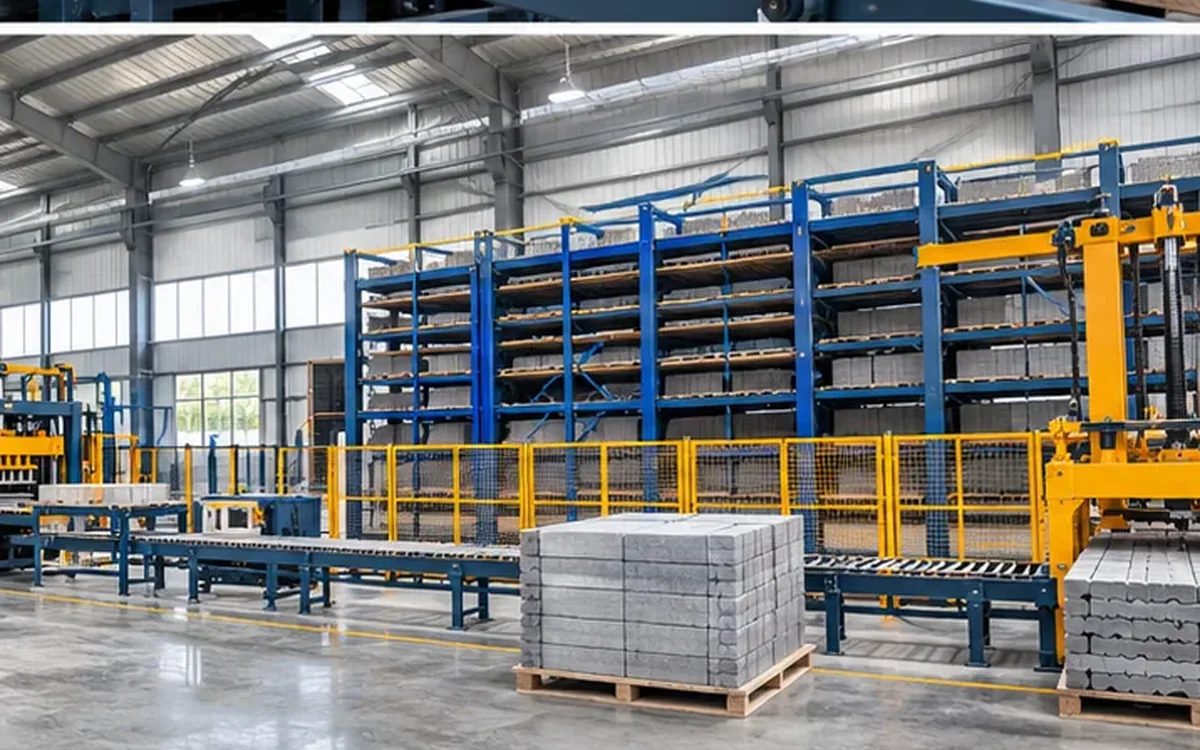
Concrete block and paver production does not end when a press completes a cycle. Once products have developed adequate handling strength, the dry side must remove them from production pallets, assemble stable packs and move finished stock toward storage or dispatch. A fast forming machine offers little commercial benefit if the cuber, packaging station or forklift route repeatedly interrupts the pallet loop. Dry-side engineering should be evaluated as a complete material-flow system with its own capacity, quality and safety requirements.
Start with finished-product geometry and pack design
Blocks, pavers and kerbstones impose different handling requirements. Hollow masonry units have vulnerable webs and corners; pavers may need face protection; long kerbstones can create awkward load centres. Determine how each product should be stacked, supported, separated and transported before selecting a cubing mechanism. The desired pack geometry influences gripper design, layer pattern and the configuration of conveying stations.
Packaging should be compatible with customer deliveries and warehouse handling. A dense stack is not necessarily stable, and a pack that is easy to form may be difficult to unload without damage. Confirm pallet or pack dimensions, expected weight, fork-entry needs and transport constraints. A good dry-side design begins with the finished unit's journey beyond the factory gate.
Establish when products can safely be handled
The dry side receives products after a curing stage, but readiness for handling should not be based on elapsed time alone. Concrete strength development depends on mixture, temperature, humidity and product geometry. Lifting or clamping units too early can create cracks or surface marks that appear only after shipment. The applicable product specification and validated plant process should determine handling readiness.
Coordinate the drying or curing schedule with the number of pallets circulating through production. If storage releases too many loads at once, the dry side may be unable to process them. If release is too slow, the press can run out of clean production pallets. The two sides of the factory must be planned as one queueing system.
Understand cuber gripping and layer handling
Cuber equipment may use mechanical gripping, side clamping, specialised tooling or other handling methods suited to the products. Evaluate contact pressure, grip surface, layer alignment and failure behaviour. A gripper that handles a standard solid block may be unsuitable for thin architectural pavers or long kerbs. Request demonstrations with representative product geometry and realistic stack heights.
Layer transfer should control acceleration and placement to reduce impacts. Inspect how the system responds to missing or misaligned units. A machine that proceeds with an incomplete layer may build an unstable pack. The recovery method for rejected layers should be straightforward, documented and safe for operators.
Choose packaging for the distribution environment
Wrapping, strapping, interlayer sheets and corner protection serve different purposes. Protection needed for a short movement around a paved yard can differ from that required for a long road or sea shipment. Packaging must account for moisture, weather, movement and the risk of surface abrasion. Excess material adds cost and waste, but inadequate protection can create expensive customer claims.
Validate packaging on representative finished packs rather than choosing by machine brochure alone. Check containment, load stability and compatibility with the customer's unloading equipment. Define inspection criteria before dispatch, including damaged straps, unstable layers, incorrect labels and broken corners. Finished-product presentation affects the perceived quality of the entire production process.
Design the pallet return loop as a critical resource
Production pallets should return to the press in suitable condition and at the required rate. The loop may include cleaning, inspection, turning, buffering and transport. A delayed return can stop the press even when the dry-side equipment is still processing finished goods. This makes pallet logistics a shared bottleneck, not a secondary warehouse concern.
Estimate the number of pallets required across forming, curing, transfer, dry-side handling and buffer positions. Include expected cycle variation, planned maintenance and changeovers. Keep damaged pallets out of the loop through a defined inspection and rejection process. Quality losses from poor pallets can outweigh the apparent savings from postponing replacement.
Measure dry-side performance with the right indicators
Nominal packs per hour are useful only when the pack format and product type are specified. Measure completed saleable packs, average transfer time, stops by cause and the percentage of units damaged during handling. Track the reasons a machine is waiting: no cured product, no empty pack pallet, forklift delay or equipment fault. These distinctions point to different remedies.
A capacity study should test realistic combinations of product formats and pack patterns. A plant with frequent changeovers may need flexibility more than maximum single-product speed. Design buffer positions carefully because they can reduce short interruptions but also conceal a chronic mismatch between stages.
Keep forklift traffic and personnel access safe
Forklift routes, pedestrian paths and storage aisles should be planned around actual dispatch volumes. Provide adequate space for turning, load inspection and temporary staging without blocking machine access or emergency exits. Automatic cubers and transfer systems require guarding and documented recovery procedures. Personnel must not enter an active handling area to straighten a pack without following the appropriate safe isolation procedure.
Coordinate the dry-side layout with the curing and handling guide and the production-line overview. A production plant reaches its true capacity when it can continuously release safely packed, saleable products—not when its press briefly achieves a headline cycle time.