
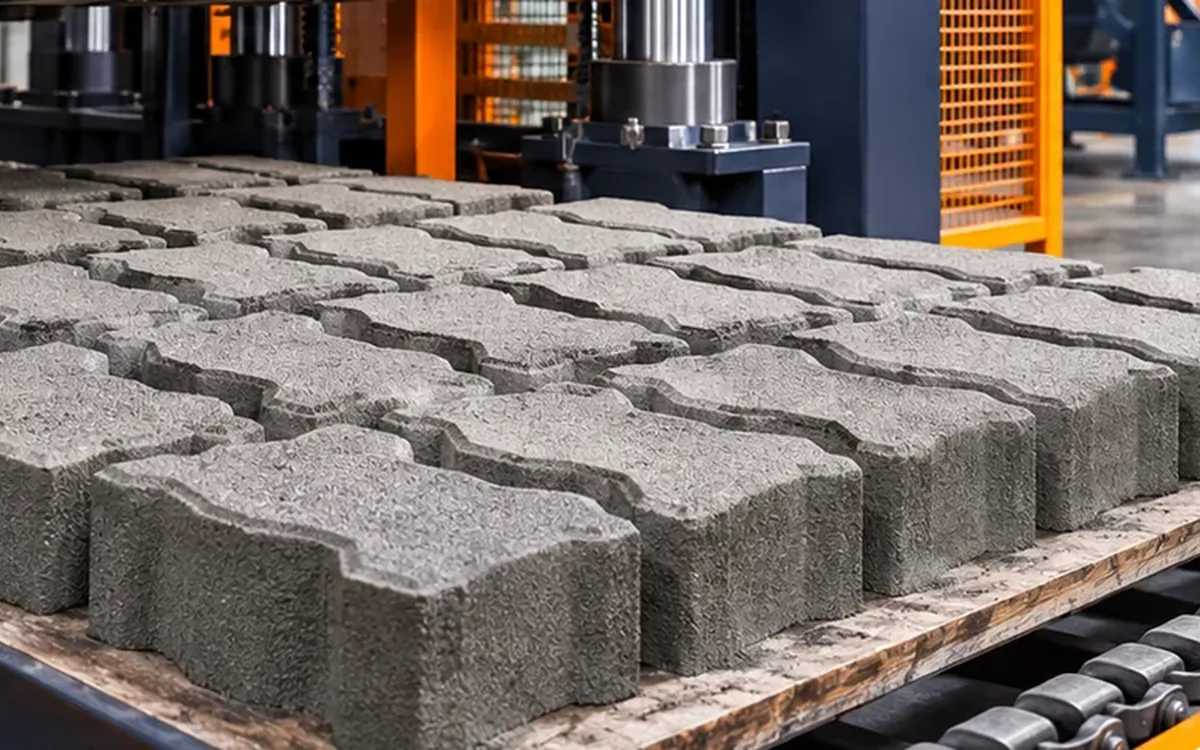
Paver manufacturing in the United Arab Emirates can involve decorative landscape products, standard paving units and specialised kerbstone profiles. Those families should be planned separately before combining them on one production line. Surface appearance and pack presentation may be commercially important, but both depend on consistent mixing, forming and curing. A successful equipment brief links the specified customer finish to the machinery and inspection process that will produce it.
Separate aesthetic goals from engineering acceptance
Record the target pattern, colour, texture, thickness and edge quality for every main product. A face-mix line needs stable fine-material handling and accurate pigment dosing; single-layer grey paving may use a simpler configuration. Confirm which products can share mould interfaces and which require changes to dry-side lifting or stacking. Performance claims should identify the actual product, not a generic high-speed paver demonstration.
Evaluate materials and exposed operating areas
The intended UAE site should be reviewed for material storage conditions, dust movement and the impact of changing aggregate moisture. Where source characteristics or environmental exposure could affect product appearance or performance, require appropriate testing. Keep colour samples under a controlled comparison procedure and retain a reference for each approved recipe. A stable shade depends on more than simply repeating a pigment percentage.
Plan curing capacity around the product portfolio
Different paving formats may need different storage residence times and handling precautions. Confirm that a planned curing arrangement will protect fresh surfaces while allowing reliable pallet circulation. The factory layout should identify where pallets queue and how an interrupted line recovers without damaging units. Avoid a design that can operate only when the press, elevator and cuber all maintain identical ideal speeds.
Specify the final pack and delivery interface
Decorative units can lose value through scuffed faces or damaged corners even when strength tests pass. Determine pack size, layer protection, wrapping and fork access before selecting the cuber. Create safe inspection and loading spaces that do not interfere with production or maintenance access. Demonstrate representative packs using the intended handling equipment and transport assumptions.
Review lifetime operation rather than only purchase price
Compare cleaning time between colours, face-mix waste, mould changes, energy demand and spare-part support. Request a signed acceptance plan covering sample quality, control functions and line handovers. Identify exclusions for extraction, utilities, civil work and operator training. The production-line systems and quality control guide can support a UAE-focused commercial and engineering evaluation.