
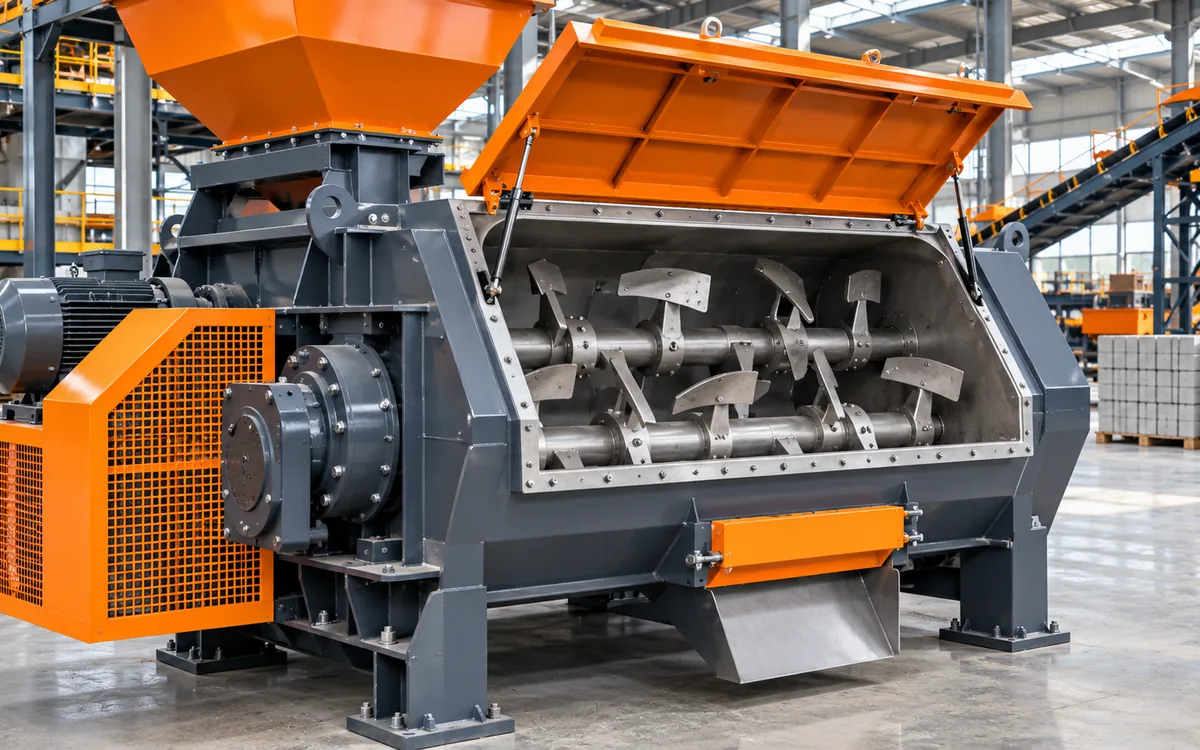
Equipment application
Planetary mixers are considered where a plant needs controlled blending of aggregates, cement, water and optional additions for vibro-pressed concrete.
Material preparation and process control
Mixer selection starts with working batch volume and realistic discharge frequency rather than the nominal vessel size alone. Cleaning access, wear liners and motor duty should be checked against the product programme.
Operating the connected production process
The mixer must work with aggregate weighing and delivery to the press. If colour or facing mixtures are required, separate handling and contamination-control requirements may apply.
Requesting a practical equipment specification
Specify material grading, batch demand, shift schedule and available power so the mixer can be matched to press consumption.
- Aggregate grading and moisture variability
- Required working batch size
- Mixer discharge and press feed arrangement
- Cleaning and liner maintenance scope
To plan planetary mixer for block plants within a complete plant, see the machinery category and the connected production line options.
Mix uniformity in low-slump production
Concrete block production commonly uses a relatively dry mixture that must still distribute cement, moisture and fine aggregate consistently. A planetary mixer should be evaluated for its ability to wet the batch uniformly and discharge without leaving dead zones. Compare the intended working batch size rather than the gross bowl volume, and discuss the effect of aggregate shape and grading on mixing behaviour.
Cleaning, batch change and wear surfaces
Different colours or mix recipes can make cleaning more important than theoretical maximum batching speed. Review access to blades, scrapers, discharge gate and wash-down points, along with guarding and isolation procedures for maintenance. Wear-liner and blade replacement should be understood before purchase because abrasive aggregates can make these routine operating tasks.
Matching batch size to the forming machine
Work backwards from the mix demand of the press and the frequency of a batch discharge. The mixer and weighing system must deliver adequately prepared material before the forming hopper runs short, without creating long storage times that change moisture behaviour. Confirm feed height, transfer distance, discharge rate and how the system handles a rejected batch.
Understanding low-slump mixing requirements
Concrete for vibro-pressed blocks and pavers often uses a relatively low-slump consistency, so mixing must distribute cement paste and moisture throughout a granular mass. An apparently uniform colour does not by itself prove that water is distributed consistently. Review the actual aggregate grading, moisture range and target batch size when assessing the mixer. The rotating tool arrangement, mixing time and sequence of adding water can influence whether the batch arrives at the press with stable behaviour. Where several products are made, different recipes may require different mixing duration. A meaningful mixer trial should evaluate the consistency of material discharged at different points in the batch, not only a single sample taken near the end.
Batch volume and feed rhythm
Mixer capacity should be specified in a way that distinguishes nominal drum volume from the working volume of concrete discharged. The batching cycle must also leave time for charging, mixing, discharge and cleaning, especially when one mixer serves a fast block press. Calculate the required average delivery rhythm from the forming-machine demand and verify that upstream weighing can keep pace. An oversized batch may stand too long before use, while undersized batches may create unnecessary starts and inconsistent feeding. The plant should have a predictable sequence that minimizes unnecessary waiting between mixes. Request a cycle demonstration using the planned mix rather than relying on a generic rated throughput from another application.
Wear components and maintenance access
Mixer arms, blades, liners and discharge components are exposed to abrasive aggregate. Ask how these items are inspected and replaced, which pieces are individually serviceable and how safely the operator can reach them. Routine cleaning must be planned around guards, access covers and proper energy isolation. If the mixer is elevated, its working platform and lifting access should be included in the plant design. Material build-up can alter effective volume and contribute to uneven batches, making cleaning time a production consideration rather than a housekeeping detail. Keep records of wear-related changes and compare them with mix quality observations so service work is scheduled before poor uniformity becomes a recurring production defect.
Water dosing and recipe traceability
Mixing accuracy depends on input measurement as much as the mixer geometry. Check how sand moisture is considered, where water enters and whether admixture dosing is appropriate for the proposed products. When water is adjusted at the press to correct poor filling, it can mask upstream inconsistency and make later troubleshooting difficult. Keep recipes, batch identification and adjustment responsibility clear. In a plant making coloured pavers, consider the risk of pigment carryover between products and the cleaning sequence needed before colour changes. A production record linking material lots, water additions and product quality is valuable for investigating reject patterns without assuming the mixer itself caused every problem.
Discharge, plant layout and material transfer
The discharge arrangement must suit the hopper or conveyor receiving concrete and should not create uncontrolled spillage or segregation. Check clear height, access to the discharge gate and the ability to inspect material flow during a stop. A mixer positioned too far from the forming machine can increase transfer time and complicate cleaning, while a cramped installation may prevent maintenance. Include dust management around cement charging and safe aggregate delivery in the layout review. For plants expanding in stages, determine whether the mixer can remain in place if the batching equipment or press is upgraded. These connections affect effective production more than a standalone mixing-speed comparison.
Acceptance checks and data for a mixer quotation
Provide expected aggregate sizes, concrete product families, daily batch requirement, available utilities and the proposed position within the plant. Ask suppliers to define the actual working batch quantity, the material assumptions behind their performance estimate and the scope of dosing and discharge controls. During commissioning, inspect repeatability across several batches and observe the condition of material at the start and end of discharge. Document cleaning time and access to typical wear parts. If a particular product must meet a specified concrete performance, define how it will be tested downstream rather than treating a mixer capacity label as proof of finished-block quality.
System integration: Mixer selection should follow the raw-material grading, target batch size, discharge method and number of mixes required for the planned mould programme. A machine that looks suitable in isolation may not match aggregate feed timing or the forming press demand. The batching and forming process explains the timing relationship between material preparation and stable press operation. Include material characteristics, moisture variation and cleaning requirements when defining a mixer quotation, especially if different colours or recipes must be made during one shift.