
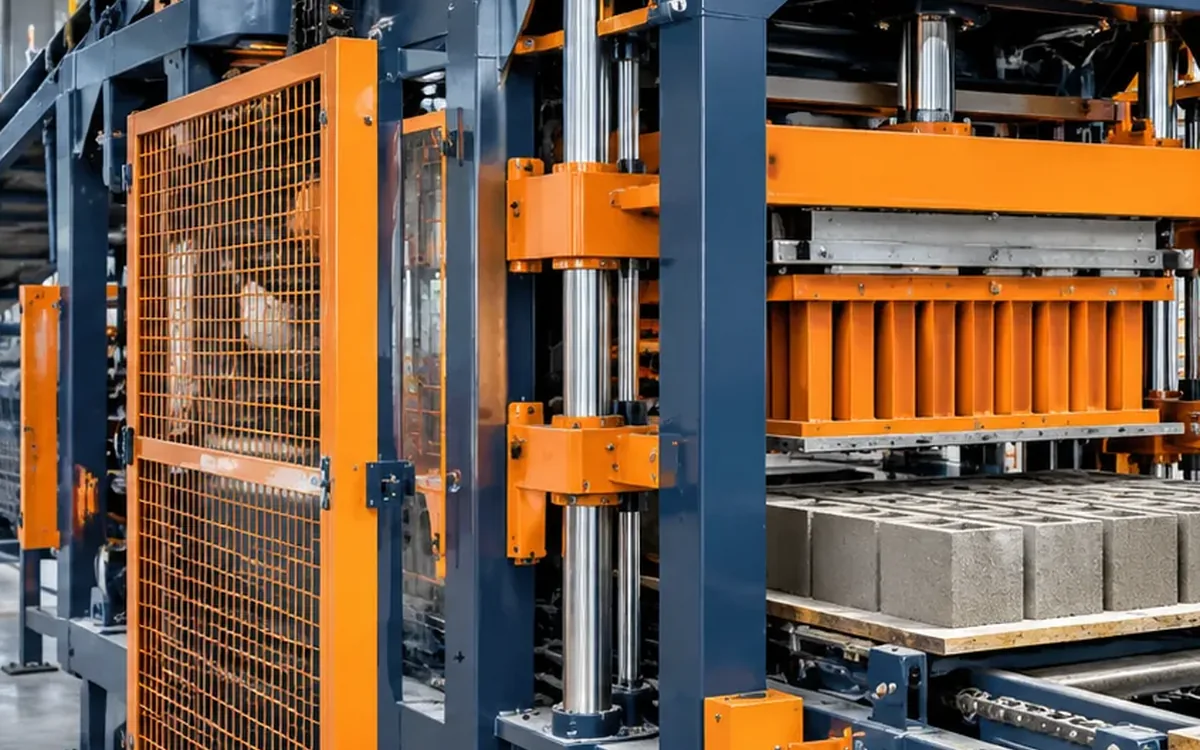
The quality of a vibro-pressed block begins before the finished unit can be lifted from the production pallet. A press must distribute low-slump concrete into the mould, consolidate the mixture without segregation, and release a unit that retains its geometry during immediate handling. Vibration, tamper movement, feed consistency and mould condition interact; treating any one of them as an isolated speed setting often produces unstable results. The objective is not the highest possible force or the shortest possible cycle, but a repeatable process window that delivers acceptable units across a full shift.
What compaction must achieve inside the mould
Low-slump concrete contains aggregate particles, cementitious binder, moisture and entrapped air. During forming, vibration helps the particles rearrange while the tamper imposes pressure and defines the final product height. The outcome depends on the distribution of material in every cavity, friction against the mould walls and the stiffness of the supporting pallet. An apparently uniform press stroke does not guarantee equal density in each product position.
Producers should examine individual cavity weights, face appearance, edge integrity and early handling damage rather than relying on one average measurement. A well-compacted sample can still be unacceptable if it shows lamination, irregular height or weak corners. The process therefore needs several complementary observations, not a single machine display value.
Why feeding uniformity comes before vibration tuning
A mould cannot compensate for material that never reached a corner or a narrow web. Feed-box travel, filling time, mix mobility and aggregate grading determine how consistently each cavity receives its intended charge. Large or awkward profiles can expose a poorly adjusted feed pattern that remains invisible when manufacturing a simpler rectangular block. Check the weight pattern across mould positions before increasing press intensity.
A useful trial compares units formed at the beginning, middle and end of a continuous run. If the same cavities repeatedly emerge light, the investigation should begin with the feed box, levelling action and mould geometry. Changing vibration parameters without solving the feed imbalance can make the product appear denser while preserving its internal inconsistency.
Vibration frequency, amplitude and duration are different variables
Frequency describes how rapidly the system oscillates; amplitude is the movement of the vibrating assembly; duration describes how long vibration is applied. Their practical effects depend on the mass of the mould and pallet, the machine structure and the concrete mixture. A setting transferred from one press model, product thickness or mould family may not produce the same results elsewhere. Supplier-recommended ranges and controlled trials are more useful than copying values seen in a demonstration video.
Longer vibration is not automatically better. Excessive energy or poorly timed pressure can encourage segregation, distort the face layer or increase component wear. Conversely, insufficient consolidation can leave porous surfaces and fragile edges. Each change should be linked to measured product quality and recorded with its corresponding batch and mould.
The tamper, mould and pallet act as one mechanical system
Tamper shoes should contact the designed areas of the concrete product without unwanted interference with mould webs or inserts. Misalignment can create local over-compaction, chipped corners and irregular unit heights even if hydraulic pressure appears normal. Worn mould guides, damaged pallets or loose mountings introduce additional variation. A periodic mechanical check should accompany process tuning so that operators are not asked to solve a worn-part problem through recipe changes.
Production pallets merit particular attention. Their flatness and stiffness influence both compaction and the transfer of fresh units into curing. A pallet that flexes or varies in thickness may produce a repeating height pattern, especially with wide moulds. Record the pallet condition when comparing test results, rather than assuming every cycle had an identical foundation.
Build a controlled trial instead of changing several settings at once
Start with a documented baseline: product dimensions, mixture identification, moisture condition, mould number, pallet condition, feed-box settings, vibration phases and actual cycle time. Run enough consecutive cycles to identify variation, then alter one parameter within the machine maker's permitted range. Collect pieces from different cavities and positions, mark them, and inspect their appearance immediately and after appropriate curing. Where laboratory tests are needed, sample and condition products according to the applicable specification.
A trial should have a written acceptance criterion before it starts. Possible observations include dimensional consistency, visible voids, green-product stability, post-curing strength and rejection rate. The fastest-looking setting is not necessarily the most profitable when breakages and downstream handling are counted. Keep the result in a recipe library with the product and mould version so it can be reproduced.
Recognise common symptoms without jumping to a single diagnosis
Crumbly edges can arise from moisture, poor feeding, inadequate consolidation or early transfer shock. Height variation can indicate uneven filling, tamper alignment, tooling wear or pallet problems. A glossy or paste-rich surface may reflect mixture or compaction behaviour rather than simply “good vibration.” These symptoms help direct an investigation, but they do not identify a cause without supporting measurements.
When several faults appear together, review the sequence from batching to demoulding. Confirm whether the mixture and the equipment changed at the same time. Separating material effects from mechanical effects makes corrective action more efficient and avoids repeated trial-and-error adjustments between shifts.
Specify useful process data when evaluating a new press
Ask the supplier what vibration and tamper parameters can be monitored, saved and recalled for different products. Confirm how feed consistency is supported, how tool alignment is checked and what preventive maintenance protects the vibration system. Request practical product trials using your intended mould geometry and material characteristics where feasible. A technical offer should explain the controls available to the operator, not merely state a nominal production speed.
For the surrounding machine and process choices, see the machine range and the guide to concrete mixing for vibro-pressed blocks. A reliable factory makes its product quality repeatable through defined procedures and measurements, not by finding one supposedly perfect press setting.