
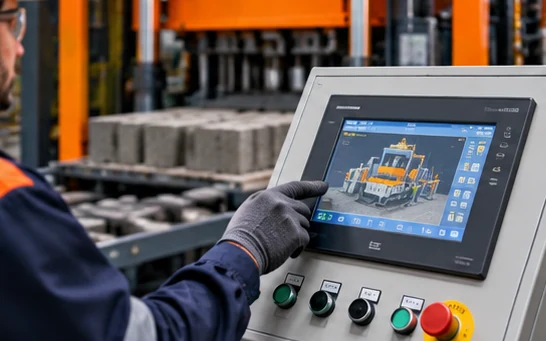
A concrete block production line contains several coordinated machines rather than one isolated press. Material feeding, compaction, pallet transfer, curing storage and dry-side handling must operate in the correct sequence while keeping workers away from hazardous movement. A PLC and human-machine interface can make that coordination visible, but software features should never be confused with verified machine safety. The right automation specification describes equipment boundaries, process behaviour, alarms, operator actions and documented safety functions.
Start with a functional description of the entire line
The control-system design should begin with a clear sequence of operations. Describe what signals permit each station to start, how a full conveyor is detected, which machine owns a transfer request and what happens if downstream equipment cannot accept another pallet. Without this sequence, suppliers may quote separate control cabinets that appear complete while leaving the integration logic undefined. A functional description allows the mechanical, electrical and software teams to work from a common plan.
Define the expected automatic, manual, maintenance and recovery modes. List the sensors, actuators, setpoints and interlocks needed in each mode. A sensible design also identifies what the operator may change and which parameters require restricted access. This prevents well-intentioned production adjustments from silently changing safety-related behaviour.
Differentiate process interlocks from protective safety functions
A process interlock may stop a conveyor because the next station is occupied. A protective safety function may stop hazardous motion when an access guard is opened or when an emergency-stop device is operated. The two functions have different consequences if they fail and should be engineered and validated accordingly. A normal PLC message is not evidence that a protective stop meets the necessary performance requirements.
Risk assessment should identify hazards throughout normal production, setup, cleaning, fault recovery and maintenance. Safety-related control design may draw on standards such as IEC 60204-1 and locally applicable machinery safety requirements; the applicable editions and conformity obligations must be confirmed for the installation. Guarding, safe distances, access control and energy isolation require consideration alongside electronic safety logic.
Define clear equipment and data interfaces
A line integrator needs an agreed signal list, communication protocol and ownership of each interface. A mixing system may report a batch ready; the press may report a pallet formed; a rack loader may report available storage positions. Specify how timeouts, connection loss and invalid signals are handled. A control panel that looks sophisticated can still conceal an unreliable interface if no one has defined the handshake between machines.
Where data are exchanged over a plant network, separate ordinary production connectivity from critical protective functions. Keep configuration backups, firmware records and a change log. Remote access can simplify support, but it should require explicit authorisation and appropriate network protection rather than leaving machine controllers exposed to the public internet.
Design the HMI around decisions operators actually make
Operators need to know whether the line is ready, running, paused, blocked, in fault or waiting on another station. Alarms should name the affected subsystem, explain the triggering condition and, where safe, provide the next approved action. A long list of numerical codes without context makes recovery slow and encourages operators to ignore persistent warnings. Trend screens should display useful process indicators instead of decorative dashboards.
Recipe selection deserves particular care in multi-product plants. Store product dimensions, compatible mould identifiers, permitted process ranges and relevant feed or transfer settings. Include an approval mechanism for changes and a simple way to restore validated values. This helps different shifts reproduce a stable result without relying on handwritten adjustments.
Define restart behaviour before a fault occurs
An interrupted pallet may be between sensors when power returns. A curing elevator may hold a load in a position that is unsafe for an automatic reset. Controls should therefore distinguish a cold start, ordinary pause, emergency stop and restart after power loss. Each condition requires a defined inspection and recovery sequence, not a generic “press reset and continue” instruction.
Commissioning tests should deliberately simulate plausible faults under controlled conditions. Examples include sensor failure, a downstream blockage, a communication timeout and the opening of an access guard. Document the expected safe outcome, the actual machine response and the authorised method of recovery. Operators should practise approved recovery procedures during training.
Capture performance data that helps improve production
The most valuable line data distinguish causes of downtime. Record when the press waits for material, when it waits for a free pallet path, when the curing system is full and when a mechanical fault prevents restart. These categories allow a team to improve the real constraint instead of blaming the highest-profile machine. Production counts should distinguish gross output from rejected or reworked units.
Avoid collecting data simply because a controller can produce it. A useful shift report might include scheduled time, actual run time, stoppage categories, product recipe, pallets processed and reasons for rejection. Establish how records will be exported, retained and reviewed. Consistent definitions matter more than dozens of charts.
Make acceptance documentation part of the purchase
Request a control narrative, electrical drawings, I/O list, safety function descriptions, alarm matrix, source and backup policy, user-access policy and commissioning test records. Define who may change software after handover and how changes are approved. Any claim of compliance should identify the applicable standard and evidence rather than rely on a generic certificate image. The buyer should also know which supplier owns problems crossing machine boundaries.
A robust automation scope supports future additions, from better pallet handling to improved process reporting. Review the production-line concepts and automation engineering solutions when preparing an integration brief. Reliable automation is measured by predictable behaviour during faults as much as by smooth operation during a perfect cycle.