
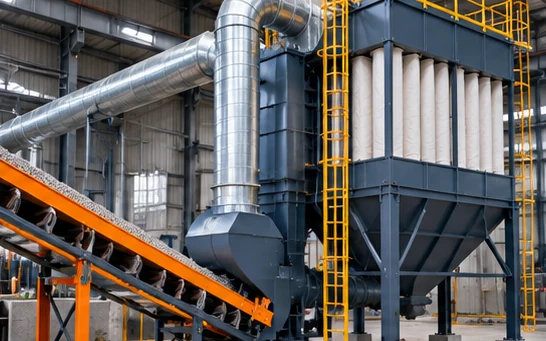
Dust and noise control should be designed into a concrete block factory before the production equipment is installed. Aggregate transfer, dry material handling, cleaning, product finishing and vehicle movement can create airborne particles, while presses, compressors and conveyors contribute to workplace noise. The correct controls depend on measured exposure, process design and local legal requirements. A tidy-looking workshop is not necessarily safe, and personal protective equipment alone should not be treated as a substitute for effective engineering controls.
Map the actual sources of dust and noise
Begin with a walk-through of the planned process, from raw-material receipt to finished-product dispatch. Identify where material is dropped, conveyed, weighed, mixed, cut or otherwise disturbed. Dry transfer points, silo connections and uncontrolled sweeping can create concentrated dust even if the main mixer is enclosed. Noise hotspots may occur around compaction equipment, vibrators, pneumatic discharge and the dry-side handling line.
Use the map to prioritise exposure assessment and layout decisions. Include maintenance and cleaning tasks, not only continuous production. A process that operates safely behind closed panels may expose workers during filter replacement or hopper cleaning. The control plan should reflect the real work performed by operators and technicians.
Treat respirable crystalline silica as a specific hazard
Some aggregates and concrete products contain crystalline silica, and activities that generate fine airborne dust can create respirable exposures. The United States OSHA specifically identifies concrete block manufacturing among activities where such exposure can occur. Workplace limits and duties vary by jurisdiction, so the site owner should obtain competent industrial-hygiene advice and check the rules applicable to its location. A generic dust mask or a housekeeping checklist does not establish compliance.
Exposure assessment should consider workers closest to the source and others affected by air movement through the building. Sampling methods, frequency and interpretation require qualified personnel. Keep records of measurements and controls, and re-evaluate when materials, equipment or operating practices change. Safety planning should remain part of ongoing production management rather than a one-off commissioning document.
Capture dust near its point of release
Local exhaust ventilation is generally more effective when capture hoods and enclosures are designed around the actual release point. Extraction ductwork, filtration and make-up air must operate together; an undersized fan can leave dust escaping even if a large filter unit has been installed. Access to inspect hoods, empty collection systems and replace filters affects long-term performance. A system that works on day one but cannot be maintained will not provide reliable control.
Airflow should be verified during commissioning and checked periodically. Follow the equipment supplier's recommendations for filter condition and safe dust handling. Where combustible or otherwise hazardous materials are introduced, additional risk assessment may be necessary; never assume a dust collector is suitable for every material simply because it is industrial equipment.
Reduce dust through containment and cleaning methods
Covered transfers, controlled drop heights, well-maintained seals and suitable housekeeping equipment can substantially reduce unnecessary airborne material. Avoid practices that deliberately blow accumulated dust into occupied areas. Use cleaning methods appropriate to the hazard and plant conditions, supported by documented procedures. Spilled aggregate should be addressed at its source rather than allowed to accumulate until the end of the week.
Plan routes for forklifts and wheel loaders so they do not repeatedly cross sensitive workstations or stir up settled dust. Material-storage design, drainage and yard maintenance also influence the cleanliness of surrounding buildings. These are layout decisions, not just cleaning-team responsibilities.
Design noise control around occupied locations
A vibro-press may be the loudest visible machine, but cumulative noise from multiple stations can be just as important. Measure exposure at actual operator locations, including setup and maintenance activities. Engineering measures may include enclosure, isolation, damping, equipment maintenance and remote positioning of controls. Hearing protection can still be necessary, but its selection should follow a documented assessment.
Check whether vibration isolation affects adjacent structures or measurement equipment. A badly installed support can transmit noise and vibration through foundations or pipework. Coordinate acoustic measures with guarding, ventilation and maintenance access so solving one problem does not create another. Workers should be trained to recognise changes in noise that may indicate a developing mechanical fault.
Verify controls after the factory enters routine production
Commissioning measurements should establish a baseline for extraction airflow, workplace exposure and noise at representative positions. During operation, compare inspection results with that baseline and investigate changes after equipment relocation, increased throughput or replacement of filter components. A collection system that appears to be running may perform poorly if a hood is blocked or a duct has developed a leak. Assign responsibility for recording inspections and correcting defects rather than treating the extraction equipment as maintenance-free.
Workers should know whom to notify when dust escapes from a transfer point or when unusual noise appears. Document the response to a failed ventilation check, including whether the affected activity must stop until an effective control is restored. Refresher training, contractor induction and planned maintenance help ensure that protective measures survive staff changes and production pressure.
Include dust control in the technical and commercial scope
A supplier quotation should identify which enclosures, extraction points and connection spigots are included. Clarify who supplies the fan, filter, ducting, controls, electrical interlocks and commissioning measurements. Plant owners should also budget for recurring consumables, inspections and safe waste handling. An offer that mentions “dust extraction connection available” is not the same as a complete dust-control system.
For authoritative background, review OSHA's crystalline silica guidance and the relevant local occupational rules. Combine that information with the machine range and plant engineering solutions when defining the facility. Dust and noise control are core engineering requirements, not optional finishing touches after production starts.