
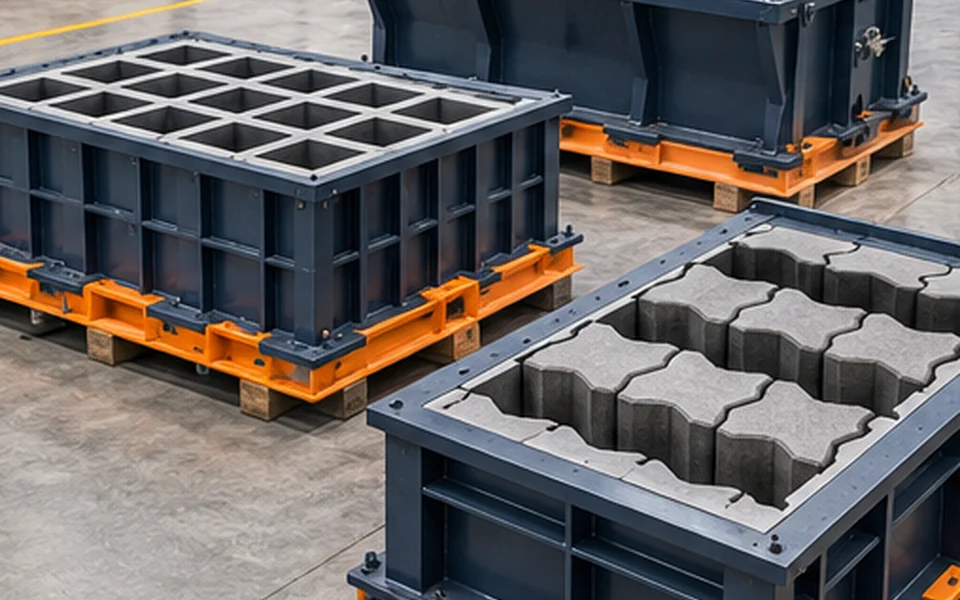
Which mould details control geometry, durability, changeovers and product consistency.
Specify the finished product accurately, including wall sections, internal cores, edge detail and dimensional tolerances. The mould maker needs the same manufacturing requirements as the block producer.
Without clear drawings, several plausible designs can produce visibly different results.
Mould size, tamper layout and the press mounting interface must agree. A mould that looks similar to an existing one may still have different clearances or a different operating height.
Review the product release sequence and any features that can cause material sticking or damaged corners.
Concrete mixes can abrade components, particularly in areas with repeated vibration and cleaning. Check which parts can be accessed or renewed and how their condition will be inspected.
Safe lifting points and storage supports reduce damage during frequent changeovers.
Prioritise the most valuable products before adding decorative variants. Many low-volume moulds can create a complex production programme without corresponding sales benefit.
When evaluating concrete block and paver mould selection, record the operating assumptions most relevant to the proposed product mix and factory conditions. Ask for a written scope of equipment, utilities and product quality verification.
For related equipment see concrete block machinery and plant configurations.
A mould should be judged by its dimensional consistency, filling behaviour and serviceability rather than just the cavity count. For hollow masonry blocks, inspect core supports and wall thicknesses; for pavers, check chamfers, spacer details and surface definition. The chosen cavity layout should not compromise pallet stiffness or create difficult-to-fill areas.
Plan where moulds are stored, cleaned and inspected, and how heavy sets are lifted into position. Record alignment references and the adjustments required before the first acceptable pallet. Where a machine is expected to change between blocks and pavers frequently, tooling exchange time can become a major element of the annual production cost.
Abrasive aggregate causes progressive wear at contact faces, liners and tamper surfaces. Ask whether critical wear parts can be replaced, how inspection is performed and what constitutes an unacceptable dimensional change. Retaining approved first-article samples makes it easier to detect drifting product geometry before the plant experiences a large rejection batch.
Start with dimensional and installation requirements
Before a mould drawing is released, define how the finished unit will be used. An interlocking paver needs edge geometry and thickness suited to its intended laying pattern, while a masonry block requires cavities and webs that can be formed consistently and accepted under local product requirements. A kerbstone may require different height and lifting considerations from either. Provide actual drawings rather than photographs without dimensions and identify which tolerances are mandatory. Discuss visible surface quality, colour, aggregate texture and any deliberate edge treatment. Mould design is not simply copying the outside perimeter of a product: corners, internal features, demoulding direction and tooling support determine whether the shape can be manufactured repeatedly. Clarify the intended product assortment so a special design does not make the plant unnecessarily difficult to maintain.
Match tool construction to the forming process
The mould must work with the machine's tamper movement, filling method, vibration system and production pallet. Check support and mounting points, reference surfaces, core retention and replaceable wear parts before ordering. Thin webs or closely spaced cavities can suffer inconsistent filling if aggregate grading and feed-box travel are not considered together. For paving with a decorative face layer, material distribution and cleaning between colours may be more influential than nominal mould size. Ask how tooling temperature, abrasion and repeated changeovers affect service requirements. Tool weight and access also matter because a mould that is difficult to handle safely can extend production stoppages. Compatibility should be documented through dimensions and an agreed process trial rather than inferred from a supplier's general catalogue statement.
Review cavity layout as a quality decision
Packing more pieces into a mould can raise theoretical units per cycle but may compromise spacing, material distribution and pallet support. Evaluate the cavity layout with the actual product height and mass, not a simplified top view. Inspect how concrete enters the corners and narrow sections and whether the tamper can provide consistent contact across the forming area. Sample from every cavity during acceptance instead of taking only the best-looking blocks from the edge of the pallet. If problems repeat in the same location, investigate feed distribution, alignment or localised wear. Compare dimension and surface requirements with the applicable product market rather than accepting visually attractive but inconsistent output. The best cavity arrangement is the one that produces reliable saleable units with a manageable running cost.
Plan changeovers, repairs and drawing revisions
Where a factory sells several product families, normal changeover time influences output and labour requirements. Check lifting points, alignment procedures, fastening access and the need for test pallets after each tooling change. Wear parts should be identified so that damaged cores or faces can be replaced or repaired with controlled dimensions. Maintain a drawing revision record linking the mould identification to the product dimensions and any modifications carried out after trials. Without revision control, two tools with similar names may generate units that are not fully compatible on site. Store moulds on suitable supports and protect reference surfaces from accidental damage. A realistic maintenance programme treats tooling as a production asset, not a one-time accessory paid for during machine purchase.
Assess mould performance through finished products
An acceptance plan should consider the actual product after forming, curing and handling. Record early shape integrity, dimensions from multiple cavities and any recurring damage during pallet transfer. Follow with the strength and durability evaluations required in the destination market, using agreed curing conditions and documented sample identification. A paver may look satisfactory at the press but show surface inconsistency after curing or packaging. A hollow block may have acceptable outer dimensions while internal web quality needs investigation. Request training in normal mould mounting, adjustment and cleaning so the factory can reproduce the trial result. Review the product development process and mould category for related engineering decisions. Correct mould selection combines geometry, process control and stable downstream handling.