
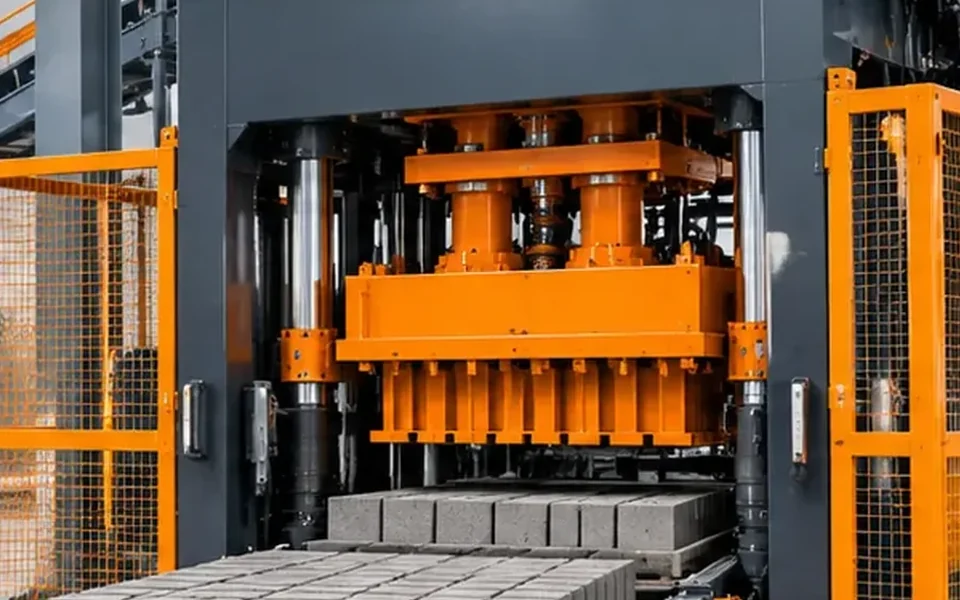
Equipment application
Semi-automatic machines can reduce the initial complexity of a plant, but their practical performance depends strongly on labour organisation and consistent operating procedures.
Forming and product requirements
Confirm which tasks require human intervention: feeding, mould change, pallet handling and stacking may each affect the labour estimate. Do not compare machine cycles with a fully automatic line without including these tasks.
Operating the connected production process
Material consistency, stable pallets and repeatable curing remain important at every automation level. The technical evaluation should cover safety around operator stations and moving components.
Requesting a practical equipment specification
Describe expected staffing, shift hours, available floor space and plans for future upgrades before selecting the degree of automation.
- Block format and cavity drawings
- Pallet footprint and product height
- Vibration and filling cycle assumptions
- Green-product transfer and curing method
To plan semi-automatic concrete block machine within a complete plant, see the machinery category and the connected production line options.
Operator-dependent stages
Semi-automatic forming generally places more responsibilities on operators, particularly for loading, transfer, sequencing and recovery after interruptions. Write an actual task sequence for one complete pallet cycle and identify which steps happen simultaneously. A nominal press cycle is not a useful production estimate if the crew cannot reliably supply concrete and remove fresh products at the same pace.
Safety and product handling
Fresh hollow blocks are vulnerable to vibration, sudden pallet impacts and uneven lifting. Review how pallets leave the machine, how operators remain outside moving equipment and how heavy tooling can be changed without manual handling hazards. A sensible semi-automatic layout uses clear guard boundaries and predictable hand-off points, even when throughput is modest.
Cost comparison beyond the purchase price
Compare staffing, training time, consumables and likely stoppages alongside the machine price. A lower-cost forming unit may still need a competent mixer, production pallets, curing capacity and a forklift or other handling arrangement. Prepare both an initial configuration and a practical expansion scenario so the value of automation can be assessed against real labour and space constraints.
Where manual work remains in the production sequence
The label semi-automatic can describe very different equipment arrangements. Identify exactly which steps need an operator: feeding, mould movement, pallet placement, green-block transfer, curing loading or final stacking. Draw the sequence with one responsible person assigned to each task and check whether overlapping duties cause predictable delays. Staffing plans should allow rest breaks and quality checks without creating pressure to bypass guards. A machine may cycle automatically while still depending on constant manual removal of pallets, so nominal cycle time is not a useful measure of daily output by itself. The purchase decision should be based on the entire work pattern and required personnel, not the automation label alone.
Ergonomics around pallets and fresh concrete units
A freshly formed pallet can be heavy, awkward and easily damaged. Review handling heights, travel distances, trolley or conveyor options and how many times an operator touches a product before curing. Repeated manual lifting adds fatigue and may introduce cracks or inconsistent pallet positioning. Where the machine allows manual pallet transfer, specify a safe route separate from vehicle movement and provide storage that does not obstruct access. Consider product sizes at the upper end of the planned range rather than demonstrating only a small unit. Guarding, stop controls and controlled recovery need to work during routine cleaning and tool changes as well as during production.
Using labour planning to assess effective capacity
Production economics should use measured work cycles that include loading, removing a pallet, inspecting output and preparing the next batch. Time the sequence with the proposed team and identify where one operator waits for another. A shift plan should also reserve time for material adjustment, mould cleaning, minor stoppages and the transfer of finished units. Where multiple products are made, include the learning curve for changeovers. The resulting forecast may look less impressive than an idealized machine-only output but is much more useful for pricing and investment. Labour availability, operator training and retention can change whether semi-automatic production remains economical over time.
Mix preparation and consistency with modest automation
When batching relies on manual control, aggregate moisture and weighing discipline become especially important. Document how raw materials are measured and how water is corrected when sand conditions change. Inconsistent batches can force constant vibration adjustments, leading to unstable dimensions and variable green strength. Keep a simple batch record linking product type, ingredient weights and observed quality so defects can be investigated. If the mixer serves several product lines, consider the delay created by moving between recipes. The semi-automatic press and its upstream preparation method should be assessed together: stable concrete arriving at the mould often matters more than shaving seconds from one forming movement.
Maintenance simplicity without losing safeguards
A simpler machine can be appealing where technical staff are limited, but simplicity should not mean unclear documentation. Request mechanical drawings, lubrication locations, replacement component identification and safe access procedures. Hydraulic hoses, limit devices, guides and wear plates need routine inspection even when production volumes are moderate. Ask how a jammed pallet or partially filled mould is cleared without uncontrolled actuator movement. A short operator handbook, practical training and an inventory of locally difficult-to-source wear parts can have more long-term value than another optional accessory. Maintenance planning should match the actual operator skill level rather than assuming specialist support is always nearby.
Comparing total investment rather than purchase price
The lowest machine price may leave pallet handling, mixer, curing, forklift movements and staff facilities outside the quotation. Compare offers using the same list of required products, daily saleable output and operating days. Add the cost of moulds, pallets, commissioning, training, utilities, waste disposal and site works. Ask whether the machine can later connect to automatic feeding or pallet transfer and what modifications that would require. If the goal is gradual expansion, a good initial layout leaves safe space for upgrades. Supply a site sketch and the proposed labour schedule when requesting a quote, so the equipment scope answers a real production need.
System integration: In a semi-automatic block factory, manual intervention is part of the actual production cycle, not an exception. Estimate workforce availability, shift breaks and safe movement of fresh products when considering output. The compact block factory illustrates how a manual or assisted transfer approach affects working space and curing inventory. To evaluate equipment properly, include the number of operators available per shift, the product drawing and the planned handling method. This makes it possible to distinguish an affordable initial plant from an arrangement that is difficult to operate.