
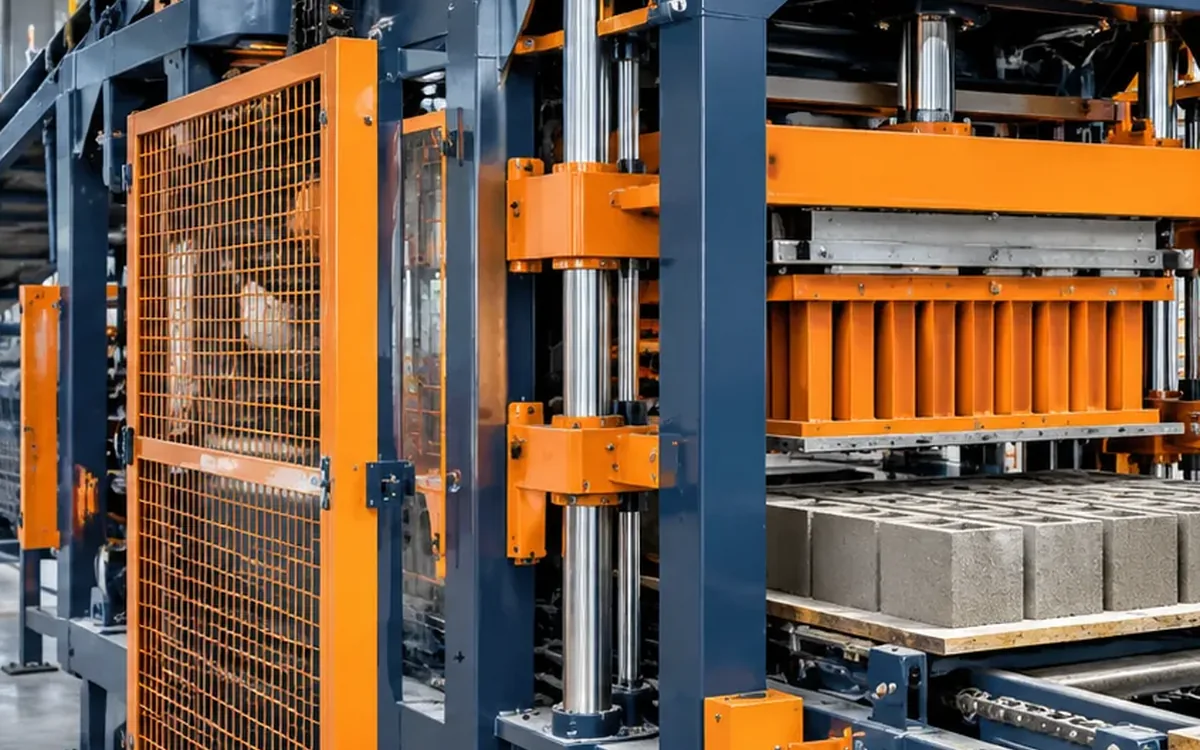
Equipment application
A compact stationary machine can be appropriate for an initial facility or a product line with a defined range of blocks. It still requires reliable material preparation and enough room for safe green-product handling.
Forming and product requirements
The practical limits of a compact press include pallet footprint, available mould volume and the number of operators who can safely manage feeding and product transfers. These constraints should be made visible during quotation.
Operating the connected production process
Plan the small plant as a complete workflow: aggregate storage, mixer discharge, block forming, drying or curing, finished stack preparation and vehicle access.
Requesting a practical equipment specification
Include a simple factory sketch, expected block sizes, estimated daily demand and whether the production plan allows later automation.
- Block format and cavity drawings
- Pallet footprint and product height
- Vibration and filling cycle assumptions
- Green-product transfer and curing method
To plan compact stationary block machine within a complete plant, see the machinery category and the connected production line options.
Small footprint, complete production responsibilities
A compact press can reduce the dedicated forming area but does not eliminate the need for aggregate storage, mixing, pallet handling, curing and finished-product dispatch. Sketch forklift approaches, operator walkways, wash-down provisions and the route for returning empty pallets. The useful footprint is the whole operating cell, including service clearance and the storage required to keep work moving between batches.
Selecting an initial product programme
An early-stage operation often benefits from a deliberately narrow range of block geometries. Start with one or two products that have predictable demand, then verify whether their moulds share dimensions and pallet requirements. Before buying additional tooling, assess how many completed pallets can be cured, where rejected units are removed and how quality checks will be recorded from the first production day.
Planning staged automation
Leave space and clear connection points for a future automatic pallet feeder, elevator or cubing station even if the initial process is partly manual. Check electrical capacity, floor loading and doorway access with the eventual layout in mind. Buying a compact machine with no upgrade path can make subsequent material handling more disruptive and expensive than the initial purchase suggested.
A compact press still needs a complete factory plan
A smaller machine can fit a modest manufacturing plan, but its material and logistics requirements do not disappear. Sketch the route from incoming aggregate to finished palletized goods before committing to building dimensions. Leave access for bulk deliveries, a mixer, empty pallets, curing and forklift manoeuvring. Where the building is narrow, check whether the machine can be serviced without blocking the only transfer aisle. Small plants may have limited buffer space, making production timing particularly sensitive to interruptions. A layout that looks efficient on paper can become unworkable if operators must cross a moving conveyor to obtain a pallet or clean a mould. The flow should be safe and comprehensible from day one.
Selecting an economical starter product assortment
For a first investment, a small and predictable product range often gives more useful capacity than frequent switches across many block types. Begin with a few products that share manageable height and mould requirements, then estimate local demand and storage needs. If hollow and solid units use different material proportions or compaction settings, document those changes rather than assuming one universal recipe. Product variety also affects how many moulds must be bought, stored and maintained. A realistic business case includes the cost of trial production, rejected units and unsold inventory during early operations. The machine should be selected for the products the plant can market, not the maximum number of hypothetical formats it could eventually support.
Material feeding and operator work around a small plant
Compact facilities often combine automated forming with more operator involvement in raw-material preparation or pallet movement. Mark the exact tasks that remain manual, along with their frequency, lifting requirements and reach distances. Assess whether the feed arrangement can maintain a consistent material supply while a worker performs inspection or stacking elsewhere. Small aggregate hoppers may need replenishing more often, and uneven moisture can change production quality quickly. Organise raw-material bins so different aggregates are not mixed unintentionally. The aim is to design a workflow that is repeatable for the planned team, rather than relying on one highly experienced operator to compensate for poor layout.
Pallet management and curing with limited space
A compact footprint does not justify crowding fresh blocks. Calculate the number of pallets formed per shift and the dwell time required before products can be safely handled. Compare rack-based curing with the available building height and transfer equipment, making allowances for humidity management and aisle clearance. Product damage while green can erase apparent savings from a cheaper conveyor arrangement. Pallets should return clean and flat enough for the mould interface, and their storage should not interrupt finished-product dispatch. Consider where rejected units will be collected and how the team will separate products from different production dates. Curing and inventory organisation are part of production quality, not optional housekeeping.
An upgrade path that does not waste the first investment
Some compact block operations grow into more automated batching, pallet return or dry-side stacking. Ask which mechanical and electrical interfaces can be retained if these upgrades become necessary. Reserve space for future conveyors, service points and panel extensions even if they are not installed initially. The preferred order of investment depends on the existing bottleneck: a faster press provides little value when curing racks or mixing time already limit output. Plan each upgrade using measured downtime and labour information from actual operation. A modular approach can reduce disruption, but only if the current layout, safety circuits and utility supply anticipate it without assuming unlimited expansion.
What to verify during a starter-plant demonstration
Use a representative block size and local-style mix to examine forming quality. Measure the consistency of cavity fill, pallet positioning and the ease of removing a mould for cleaning or maintenance. Ask the operator to explain startup, recipe adjustment and a controlled stop after a blocked transfer. The quotation should identify which items are basic equipment and which are optional: mixer, pallet magazine, mould set, curing racks, conveyors and on-site instruction can all affect the complete cost. Provide the available plot dimensions, expected staffing, product list and power conditions so the proposal is suited to an actual installation rather than a generic compact-machine price.
System integration: A compact stationary press is most useful when the surrounding material supply and curing routes are simple enough to support steady operation. Verify the available working aisle, pallet movement method and operator involvement before interpreting a cycle-time claim. The compact factory layout explores how a smaller building can accommodate batching, forming and dispatch without unsafe crossings. When seeking a proposal, state the available floor dimensions, loading access, pallet requirement and products intended for the first production stage.